
Retail investors' money moves faster than Wall Street roadshows
While global retail investors are still waiting for SpaceX's official IPO tomorrow, crypto retail investors have been trading around SpaceX's equity for three months.
As of June 10, more than 15 crypto exchanges and platform protocols in the crypto space have sold SpaceX pre-IPO products to retail investors. Binance, OKX, Bitget, Hyperliquid, Coinbase, Bybit, Kraken, and others have all entered the market, rolling out a complete product line from perpetual contracts to SPV tokens (indirectly holding SpaceX shares through a specially established holding company, then tokenizing the shares to sell to retail investors) and tokenized IPO allocations within two months.
According to Coin Metrics data, as of June 9, for perpetual contracts alone, the total open interest across all platforms exceeded $385 million, with peak daily trading volume surpassing $250 million and cumulative trading volume reaching $2.7 billion.
In addition, Bitget packaged its $61 million holdings into a product and sold all of it to retail investors. Platforms like Gate.io, MEXC, and BitMart collectively sold over $35 million, bringing the total distribution of pre-IPO tokens to nearly $100 million. Meanwhile, Kraken opened up $400 million in SpaceX subscription quota through its xStocks framework, and Bybit's IPO Express had a $100 million quota.
From IPO allocations and SPV shares to perpetual contract positions, the actual capital investment and risk exposure of crypto retail investors in SpaceX have exceeded $1 billion.
What Exactly Are Crypto Retail Investors Buying in SpaceX?
In April, pre-IPO perpetual contracts were still a niche category only available on Hyperliquid, with daily trading volume of just a few million dollars. Two months later, Binance, OKX, and Coinbase all entered the market. This spread speed is rare in the history of crypto derivatives, faster than the rollout of contract trading and meme coin categories.
The catalyst was an IPO of an AI chip company. On May 14, Cerebras went public on Nasdaq, with underwriters pricing it at $185 per share, and it opened directly at $350. In the last hour before the opening, the VWAP of CBRS perpetual contracts on Hyperliquid was $354.54, with a deviation of only 1.3%!, (MISSING) traditional private trading platforms Forge and EquityZen had a deviation of up to 35%!., (MISSING) On-chain contracts provided the pricing closest to the opening price without the participation of underwriters, and every CEX product manager saw the same thing.
The entry race unfolded rapidly in May. OKX was the first to launch pre-IPO perpetual contracts, followed by Trade.xyz on Hyperliquid with a first-day trading volume of $33 million. On May 21, Binance entered, marking a turning point. According to CoinDesk data, before Binance's launch, the daily trading volume of the entire pre-IPO perpetual market was about $20 million. After Binance entered, the daily trading volume exceeded $100 million on 4 out of 7 days, with a cumulative total of $400 million. On June 4, Coinbase launched SPCX-PERP, the last major player to enter, filling the final gap.
Beyond perpetual contracts, Bitget allocated $61.1 million in SPV tokens through Republic, followed by Gate.io, MEXC, BitMart, and others. In early June, Kraken and Bybit opened tokenized IPO allocations through xStocks, with a combined quota of $500 million. All three product lines were rolled out within two months.
Classified by compliance level, the current pre-IPO token products on the market can be roughly divided into five tiers, with huge gaps between each tier. The $1 billion capital scale is distributed among these five tiers, with extremely high concentration.
Perpetual contracts: users are buying a price bet. Perpetual contracts are the category with the largest trading volume and the most participating platforms. All major mainstream trading platforms have now launched SpaceX perpetual contracts, with a maximum leverage of 10x. The pricing is determined by on-site game theory and has no legal relationship with the underlying equity. Retail investors are buying a price exposure and cannot get any shareholder rights. This tier contributes the largest share of the $1 billion, with total open interest across all platforms at $385 million, cumulative trading volume at $2.7 billion, and Binance alone accounting for 65%!., (MISSING)
SPV mirror tokens: users are buying economic rights at the contract level. SPV mirror tokens are the tier with the most diverse participation methods, including PreStocks accessed via Binance Web3 Wallet, Bitget IPO Prime, etc. The compliance foundation that makes Bitget IPO Prime work is Republic, a U.S. compliant crowdfunding platform founded in 2016, whose core practice is to embed SPV into its private placement and crowdfunding ecosystem. Even though they take the same SPV path, different platforms have essentially different approaches. Ken, the product director of Bitget IPO Prime, gave a specific comparison in an exclusive interview with Foresight News: Bitget IPO Prime issues tokens after directly acquiring SpaceX old shares through Republic, with a shorter underlying asset chain. Some platforms participate as technical service providers and do not directly hold underlying assets themselves; their asset pools involve multiple layers of counterparties. The longer the chain, the higher the difficulty of verifying the legal structure.
According to him, Bitget chose to sign a 1-2 year exclusive cooperation with Republic, opened a special pool for preSPAX, directly acquired the corresponding number of old shares at a 1:1 ratio to the public offering scale, and completed legal due diligence on the authenticity of assets and the reliability of counterparties before the acquisition.
A virtual asset trading platform licensed by the Hong Kong SFC provides another window to observe the operation of the SPV path. In May 2026, the platform cooperated with a Singapore MAS-licensed institution to complete Asia's first compliant tokenized distribution of SpaceX equity-linked depositary receipts. The platform's head told Foresight News that this product structure is divided into three layers: the first layer is original shareholders such as SpaceX's early VCs; the second layer is the SPV holding the shares; the third layer is the front-end trading platform directly facing users. The total distribution of SPV tokens is nearly $100 million, giving users economic rights at the contract level, but whether these rights can be fulfilled depends on the authenticity of the underlying assets and the validity of the SPV legal structure.
Tokenized IPO allocations: users are buying price exposure close to the offering price, supported by 1:1 physical share custody, but without shareholder status. Kraken and Bybit opened SpaceX IPO allocation subscriptions to users in more than 110 countries around the world through the xStocks framework under Payward. Each token is supported by 1 physical share held by a custodian institution at a 1:1 ratio, but Kraken's documentation clearly states that the holder has no voting rights and does not constitute direct ownership of the underlying shares. The combined allocation quota of the two is $500 million, which is the largest single segment of the $1 billion.
SEC-registered on-chain equity: users are buying real shares. Backpack, together with SEC-registered transfer agent Superstate, launched the Opening Bell program to natively issue legally valid SpaceX shares on the chain, and users obtain actual shareholder status. This is the most compliant path, but also the slowest to advance; it had not been officially launched by early June.
The last tier is Gate.io's SPCX; users are buying a financial contract. An industry insider also pointed out that Gate.io's SPCX is a type of contingent payment note, with extremely limited disclosure of underlying hedging exposure, and its compliance framework also lacks a unified standard in traditional finance.
The trade-off structure of these five tiers is clear: the higher the compliance level and the more complete the user rights, the slower the product advancement and the smaller the user scale covered. The most compliant SEC-registered equity is still in the waiting list stage, while the lightest perpetual contracts have already achieved hundreds of millions of dollars in trading volume and 65%! market concentration., (MISSING)
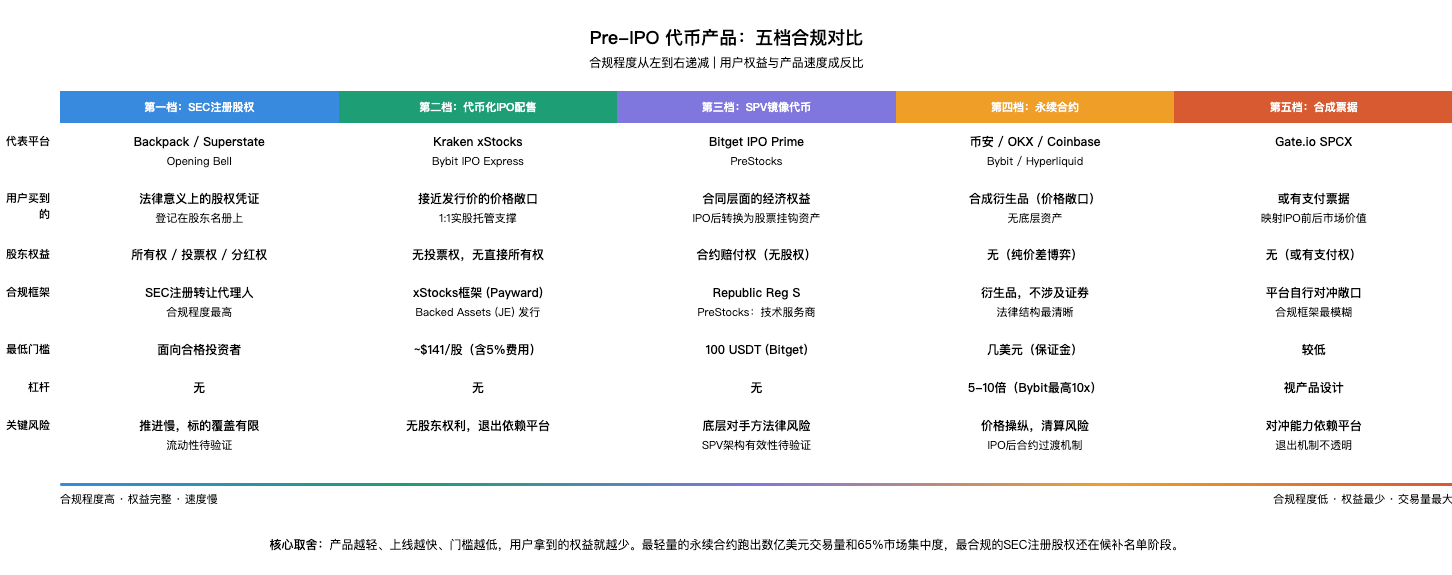
Interestingly, the inverted relationship between trading volume and user rights also holds true in pricing ability: perpetual contracts, which give users the least rights, have the most accurate pricing. There is no positive correlation between complete rights and accurate pricing. Retail investors chose the product with the lowest threshold and fastest speed, and this product also happens to provide the most effective price discovery.
The Same SpaceX, Four Prices in Four Markets
Interestingly, the SpaceX quotes that retail investors see on different platforms differ so much that they seem like completely different assets.
On June 10, Bitget's preSPAX (SPV token) was quoted at about $156, Binance's SPCX perpetual at about $174, and OKX's SPACEX perpetual at about $191. On Hyperliquid, which had not yet executed Rebase, SPACEX-USDH was still quoted at about $1982, a spread of more than 10 times compared to other platforms.
The root cause of the spread is, on one hand, that different platforms obtained different original prices before launching their products, and the subscription prices also differ. At the same time, some pre-IPO perpetual contracts are priced at "per share", but SpaceX had never disclosed the exact total number of shares before submitting its S-1. Each platform can only estimate on its own.
There is also no effective arbitrage channel between platforms. preSPAX on Bitget cannot be converted into PreStocks' SPACEX, let alone directly hedged with old shares on Forge. Holders on each platform are actually locked into a single issuer until SpaceX goes public. When the liquidity of a small platform suddenly dries up, the slippage and liquidation risks faced by retail investors are far higher than trading on mainstream platforms.
On June 1, SpaceX submitted a revised S-1A, disclosing approximately 13.08 billion fully diluted shares, which deviated from the previous estimates of most platforms. Various platforms began to adjust their share capital standards one after another and Rebase the prices of SpaceX-related products.
OKX took the lead in executing Rebase on June 2, adjusting the share capital from 1 billion to 12.52 billion shares as disclosed in the S-1 in one step, with an adjustment ratio of 12.52x, and the contract price dropped directly from over $2000 to the range of $150 to $200. Binance's SpaceX (SPCX) Pre-IPO perpetual contract had a Rebase clause reserved at launch, stating that a share capital deviation of more than 3%! would trigger an adjustment; (MISSING) after the S-1A was announced, the deviation far exceeded the threshold, so Binance officially announced a Rebase at a ratio of 1.1x on June 8, which was executed on June 10. Trade.xyz clearly stated that it would not execute any Rebase, so its price is still around $2000.
After Rebase was completed one after another, prices across platforms began to converge. According to Coin Metrics data, as of June 8, the VWAP of SPCX perpetual contracts across all platforms had converged to $155, a premium of about 15%! over the $135 offering price, (MISSING) implying a valuation of about $1.94 trillion. However, short-term arbitrage opportunities also emerged during the convergence process. After Binance confirmed the Rebase, the cross-platform spread once reached as high as 10%!; (MISSING) institutions and market makers established long positions on Binance (which was about to Rebase) and equal short positions on Trade.xyz (which had completed market pricing). Once Rebase was executed and prices on both sides converged, they could lock in certain profits.
Liquidity fragmentation is just a surface problem; the underlying product risks are more substantial.
Arkstream Capital's research found that at a valuation level of $1.2 trillion, less than 10%! of the pre-IPO shares labeled as SpaceX on the market can actually be delivered; (MISSING) multiple intermediaries repeatedly list the same batch of shares, and the nominal supply is far greater than the actual holdings. The implied valuation of PreStocks' Anthropic token once reached $1.5 trillion, while the underlying SPV actually held only about $23 million in assets.
On May 13, Anthropic and OpenAI publicly stated that share transfers via the SPV method are invalid under their articles of association, and the tokens of the two companies on PreStocks immediately plummeted by 34%! to (MISSING) 39%!., (MISSING) This is the largest single risk event for pre-IPO crypto products to date, directly exposing the legal fragility of the SPV path.
The compliance framework of Gate.io's SPCX is also questionable. "Contingent payment notes" lack a unified regulatory standard in traditional finance, and Gate.io has almost no public disclosure of the specific arrangements for underlying hedging exposure, making it difficult to assess the counterparty risks actually faced by users.
In addition to product-level risks, the revenue structure that exchanges obtain from pre-IPO perpetual contracts is also worth paying attention to. The volatility of pre-IPO targets is far higher than that of BTC and ETH. Retail investors overwhelmingly go long on these contracts, while short positions are mainly held by market makers and arbitrageurs. When the vast majority of positions are in the same direction, long positions need to continuously pay funding fees to short positions, which is a structural fee. Exchanges themselves charge fees on each transaction and penalties in each liquidation. With Binance's 7-day trading volume of $400 million, this category is a new high-margin product line for exchanges. Retail investors are paying a premium for the narrative of "participating in unlisted giants", while exchanges and market makers are steadily profiting on the other side.
In the final analysis, pre-IPO crypto products have lowered the entry threshold, but not the underlying risks. Traditional finance uses qualified investor certification and high thresholds to filter out participants with insufficient risk tolerance. This mechanism has its rough side, but also its rationality. Crypto platforms have opened the door, but the risks behind the door—differences in product rights, the authenticity of underlying assets, uncertainty in the IPO transition, and liquidity fragmentation—have not disappeared due to the lower threshold; they have just been transferred from the shoulders of institutional investors to retail investors.
SpaceX Is Just the First Shot
SpaceX is the first super target of pre-IPO crypto products. Its large IPO scale and high attention have pushed an originally marginal experimental category into the spotlight of the industry. But it is obvious that this competition will not end with SpaceX's listing on Nasdaq on June 12.
OpenAI is valued at $852 billion, targeting an IPO in September, with an IPO valuation that may exceed $1 trillion; Anthropic confidentially submitted its S-1 on June 1, just completed a $65 billion Series H financing, with a latest valuation of $965 billion, close to $1 trillion, and the market expects an IPO around October. Only these two plus SpaceX will have a combined market value of more than $3.5 trillion entering the public market one after another in the second half of 2026.
Currently, Nasdaq's Fast Entry rule has taken effect on May 1, and the S&P 500 is also proposing to shorten the fast inclusion waiting period from 12 months to 6 months. The cycle from a large IPO to being allocated by index funds is being drastically compressed, and passive buying from index funds will pour in quickly after listing. This makes the exit certainty of pre-IPO positions higher, which is also the underlying logic for the continuous attractiveness of this category. The advancement of each super IPO will bring a new round of demand impulse to pre-IPO crypto products.
Pre-IPO perpetual contracts may only be a transitional product. The tokenization roadmaps of Binance bStocks, Kraken xStocks, and Coinbase all aim to trade all U.S. stocks on crypto platforms. As long as the SEC's innovative exemption framework is not implemented, these plans cannot be formally promoted in the U.S. SpaceX Pre-IPO is the first stress test of this larger infrastructure plan, and the results of the test will directly affect the exchanges' next decisions in the tokenized stock track.
From a longer-term perspective, the educational significance of pre-IPO tokenized products may exceed their current trading volume. SpaceX, OpenAI, and Anthropic have acted as entry points, allowing global retail investors to access for the first time concepts and tools that previously only belonged to qualified investors. Such products have objectively played a role in financial equality,