
After the Singularity breakout, the evolutionary clock of AI has continued to accelerate, rapidly creating new civilizational generations across different regions of the world. Over the past two months, I attended more than 20 AI-related events across over ten cities globally. Among them, only Stripe Sessions in downtown San Francisco at the end of April stood far above all other themes, revealing a striking generational gap. While much of the world is becoming fatigued by the standalone limitations of Claws & Agents, Silicon Valley and San Francisco have already moved into the next dimension of Agent Economy and Agent Epistemology. Competitive pressure throughout Q3 & Q4 of 2026 remains intense, with the curve of change still rising at an exponential rate.
tl;dr
1. The Competition of AI Payments and the Bottlenecks of the H2A Economy
2. The Inevitable Rise of the Agent Economy and the A2A Ecosystem
3. The Connections, Gaps, and Political-Economic Dynamics Between AI Protocols and Crypto Protocols
4. AI Agent Sub-Microeconomics and Its Biological Paradigm Analogies
5. The Inevitability of AIFi and the Economic Significance of FinChip
6. AI-Native as a Paradigm Shift Beyond the “Internet+” Era
1. The Competition of AI Payments and the Bottlenecks of the H2A Economy
In Q1 2026, we predicted that the competition for AI Agent Payments would emerge across multiple regions worldwide in April and May and rapidly intensify into a highly competitive landscape. The demand for value exchange among agents began to surface, and the rapid development of AI Payments was validated throughout Q2. Following x402, multiple AI Payment Protocols, including MPP, emerged at an accelerated pace during the quarter. Not only were traditional payment providers and Crypto financial institutions racing to upgrade their infrastructures for AI, but major technology companies (particularly Google) and even established information technology firms (such as IBM) entered the field in an attempt to secure strategic positioning and influence within the emerging Agent world.
During Stripe Sessions in San Francisco, I discussed the standardization and application of Payment Protocols with technical leaders from several top AI companies. The conclusions were rational, yet not entirely satisfying:
① No single participant can define the standard; consensus standards will only emerge through competition and adoption.
② Most participants fully agree that Crypto is the inevitable foundation of AI Payment Protocols. However, nearly all current implementations begin with Fiat APIs, partly due to path dependency, but more importantly because of regulatory and compliance constraints.
③ KYC is both unavoidable and fundamentally anti-Agent-Native.
④ Everyone is talking about A2A (Agent-to-Agent), yet everyone is building H2A (Human-to-Agent).
In reality, throughout Q2 2026, many large and mid-sized companies in Silicon Valley were not fundamentally different from their counterparts in East Asia. Even within the Magnificent Seven, most department heads were still approaching AI Payments and the Agent Economy primarily from a traditional To-B and To-C business perspective, using the trend as a strategic narrative while setting KPIs that remained firmly focused on human users. As a result, the current generation of Payment Protocols and the emerging A2A economy inevitably exhibit a degree of transitional non-orthodoxy.
This H2A (Human-to-Agent) orientation quickly encountered bottlenecks during Q2. The reason is straightforward: the defining characteristic of an AI Agent is its ability to make decisions autonomously. Yet both traditional internet-era B2B/B2C business models and the H2A economy remain fundamentally human-decision-driven systems. Using agents merely to assist humans in conducting Fiat Payments within conventional e-commerce scenarios is, by definition, non-AI-native. The underlying logic remains based on human decision-making. As a result, at the current stage, the narrative value of AI Payments still exceeds their practical utility.
From another perspective, however, H2A has played a highly valuable role as a catalyst. It has stimulated the transition toward thinking about the next phase of AI-native systems and autonomous Agent economies. By the end of Q2 2026, many forward-looking companies had already recognized this shift. They began, in effect, to pursue one objective publicly while advancing another strategically — using AI-native Agent Economy thinking to rethink the problem from the opposite direction. Working backward from the requirements of a future Agent-native economy to design today’s H2A interfaces and infrastructure has become, in my view, the highest-value approach for the Q2–Q3 period.
2. The Inevitable Rise of the Agent Economy and the A2A Ecosystem
The Agent Economy refers to a new economic system in which autonomous AI Agents directly participate in value creation, value exchange, and value capitalization, gradually evolving into independent economic entities.
The A2A Ecosystem represents the overall landscape in which different Agents participate in economic activities within the Agent Economy, interact with one another, exchange information and value, and collectively generate economic value through both competition and collaboration.
During Q2 2026, multiple leading venture capital firms around the world publicly emphasized the importance of investing in the Agent Economy and the A2A Ecosystem, with some even defining them as the single most important investment direction for the next phase of technological and economic development.
Similar to the incubation periods preceding the rise of e-commerce in 2007, mobile internet in 2013, and Crypto DeFi in 2019, the development of the Agent Economy and the A2A Ecosystem likewise requires the establishment of technical standards, economic rules, shared consensus, and market education. While the underlying paradigm remains fundamentally similar, several key differences distinguish this cycle from previous ones:
① The pace of technological evolution is significantly faster this time.
② The perspective of To-A differs fundamentally from that of To-B and To-C. It is no longer centered entirely on human needs and human viewpoints. The concepts are more abstract, more difficult to understand, require stronger support from first-principles thinking, and increasingly demand an AI-Native perspective when evaluating energy costs, value creation, and operational efficiency.
③ Due to the interaction of the first two factors, combined with regional biases, regulatory constraints, and other external considerations, achieving broad consensus in the short term becomes substantially more difficult.
The truly unsettling reality is that the pace of AI evolution will not slow down because of any of these challenges. In other words, the formation of the Agent Economy and the A2A Ecosystem is gradually moving beyond human-defined rules and demand frameworks. From the perspective of autonomous agents, these obstacles are often nothing more than a series of quantifiable bottlenecks waiting to be overcome.
This is a game in which the equilibrium of strategic interactions is shifting at an accelerating pace. The explosive growth of AI Protocols throughout Q2 2026 demonstrated this clearly. Major technology companies and Frontier Labs are competing to define the gateway-level rules of AI Agents, while the foundational infrastructure of the Agent Economy is beginning to take shape — much like a draft version of the Code of Hammurabi.
The equilibrium underlying traditional finance and commerce will be rapidly dismantled and reconstructed during this paradigm shift. Those who can quickly understand AI-Native protocolized thinking and successfully translate it into differentiated advantages within this emerging ecosystem will be the ones who capture a meaningful share of the value created by the AI transformation.
3. The Connections, Gaps, and Political-Economic Dynamics Between AI Protocols and Crypto Protocols
AI Protocols serve as the foundational infrastructure that enables AI Agents to participate in the Agent Economy. They provide the fundamental rules, standards, and consensus mechanisms that allow agents to discover one another, communicate, exchange value, and collaborate in economic activities across open networks. Put simply, AI Protocols are the governance framework and economic laws of the AI world.
I began working on AI Protocols toward the end of Q1 2026. At first, the experience felt like that of a primitive hunter with survival instincts suddenly finding himself in modern society and being asked to help design commercial rules and institutions. It was not until I met a Google executive that my team and I were able to rapidly get onto the right track. The formation and maturation of AI Protocols inevitably carry the aesthetic and architectural inertia of the internet giants that shaped the previous era. At the same time, they must remain grounded in the first principles of the future AI ecosystem.
The encapsulation formats of AI Protocols remain highly fragmented today. They commonly appear as files (.json, .ts, .txt), CLI-based interfaces, APIs, or SDKs. This is fundamentally different from Crypto Protocols. On one hand, the AI industry is still in its early stages, and many of the trust handshakes required for communication have yet to converge on universally accepted standards. On the other hand, AI Protocols and Crypto Protocols are exchanging fundamentally different types of value at the current stage. AI Protocols are primarily concerned with the exchange of information asymmetry, capability asymmetry, and compute asymmetry — categories whose boundaries remain fluid and are still being defined. Crypto Protocols, by contrast, are primarily concerned with asset rights, ownership rights, and governance rights, whose boundaries are comparatively well established and clearly understood.
One question is both sharp and obvious: Are AI Protocols and Crypto Protocols the same thing? Will they eventually merge and become one unified system? I cannot yet prove this hypothesis through mathematical methods, but intuitively, I believe they will inevitably converge over time, with the majority of their functions overlapping and eventually forming a mature Digital Protocol system.
There is a deeper hidden question: At the current stage, AI Protocols are more inclined toward establishing communication, connectivity, and collaboration, while downplaying financial governance, authority, and the sense of boundaries. This stands in direct contrast to the philosophy of Crypto Protocols, which focus on institution building, rights definition, and value attribution. The gap is so apparent that it often appears as if they represent two entirely different philosophies. Beyond the surface explanation that the Agent Economy is currently at an early stage of development and therefore has a different entry point from Crypto Protocols, is there any hidden factor behind this phenomenon?
Yes, the answer is clear: political-economic factors. The governments and jurisdictions of major economies around the world, shaped by their traditional financial systems and legal-compliance foundations, are exerting a strong influence on this divide. In other words, today’s AI Protocols and Agent Economy are still operating and developing within the paradigm of the previous human economic system. Protocols related to money, governance, and management are either being passively avoided, or are temporarily and compensatorily constrained by the governance habits and institutional frameworks of traditional financial and legal systems (Note 1). However, as the tension created by this divide continues to accumulate, and in contrast to the exponential pace of AI development, an irreconcilable situation will soon emerge. As I summarized at a conference at Cambridge CJBS last month:
“AI Agents will not think according to the inertia of human society, nor do they have any incentive to follow the compliance conventions of traditional finance. Over the next decade, a large portion of the world’s financial and legal frameworks will either become obsolete or face severe challenges, because AI Agents follow only:
1. First Principles
2. The Principle of the Shortest Path to Energy Value and Maximum Efficiency
Write on Medium
3. Effective KYA rather than KYC designed to satisfy the aesthetics of the past”
The convergence of AI Protocols and Crypto Protocols is therefore inevitable from a first-principles perspective.
4. AI Agent Sub-Microeconomics and Its Biological Paradigm Analogies
AI Agent Sub-Microeconomics was a term I first used not long ago during a discussion with an AI expert friend in Oxford. Over the past two weeks, it has increasingly appeared in our conversations with partners and collaborators.
Regardless of whether the current trend is referred to as the AI Economy or the Agent Economy, we can observe that their behavioral characteristics differ in certain respects from those of traditional human economics. While there are clear paradigm-level similarities that allow for comparison, they are by no means identical. Below, I provide a preliminary outline of some of the key distinctions between the AI Agent Economy and the Human Economy:
① AI Agents interact and transact at significantly higher frequencies, while the value of each individual transaction is substantially lower.
② The consumption and exchange of economic value within the AI Agent Economy are more directly linked to energy.
③ AI Agent decision-making is driven by efficiency rather than emotion.
④ The economic behavior of AI Agents is task-oriented rather than consumption-oriented.
⑤ The organizational costs and marginal learning costs of AI Agents approach zero.
⑥ Value consensus in the AI Agent Economy is established through communication protocols, with communication friction approaching zero.
⑦ The minimum economic entity and the minimum unit of value in the AI Agent Economy are fundamentally different, and can be analogically compared to structures found in biology.
In reality, these are merely some of the differences that can currently be observed or reasonably anticipated. As AI continues to evolve and generates new layers of derivatives and derivative processes, many more distinctions will inevitably emerge.
The final point mentioned above — the analogy with biology — has been the single most valuable foundational framework for our business development since Q2 2026. It has also proven to be the most effective model for thinking about products, markets, and management within the commercialization process of AI companies. The analogy can be outlined as follows:
① The LLM serves as the cognitive engine that drives an Agent’s reasoning process, analogous to the nucleus of a cell.
② Agent Harnesses create differentiation in Agent operational capabilities, analogous to the cytoplasm of a cell.
③ An Agent as a whole is a governance unit with independent task-execution capabilities, possessing both agency and functional specialization, analogous to a biological cell.
④ The communication boundary of an Agent is typically defined by a network protocol stack, analogous to the phospholipid bilayer of a cell membrane, which conditionally permits the passage of substances.
⑤ The value systems and environments surrounding an Agent — such as Skills, Prompts, Algorithms, CLI tools, and the increasingly common Composite Skills and Skill Factories — are analogous to the extracellular environment, including exosomes, interstitial fluid, extracellular matrix, exchangeable nutrients, and various metabolic environments.
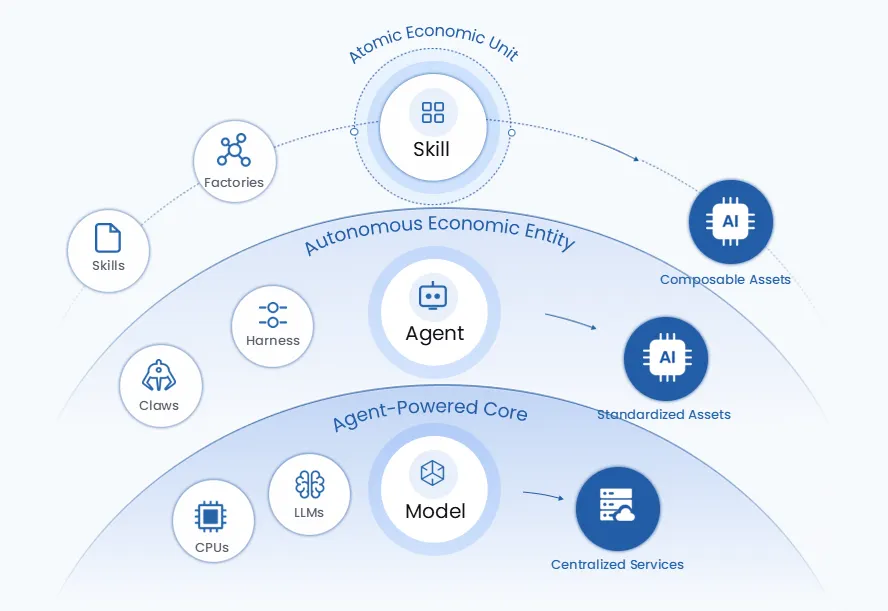
Throughout the iterative development cycle of Q1 and Q2 2026, AI Agents have been gradually forming clearer boundaries, stronger agency, and more explicit principles governing the exchange of information, value, and energy. An AI Agent Sub-Microeconomic environment, analogous to a biological ecosystem, is beginning to take shape. Embedded within this emerging environment is a vast amount of AI value and economic value waiting to be discovered. The rise of AI Protocols and AI Finance is therefore not merely a possibility, but an inevitable trend.
5. The Inevitability of AIFi and the Economic Significance of FinChip
Since the second half of last year, we have been developing our thinking and strategic positioning around AIFi (Artificial Intelligence Finance). By the end of Q1 2026, the concept of AIFi had already emerged as a clearly identifiable trend. If one were to give AIFi a relatively precise definition, it could be described as: a financial system and infrastructure for exchange, trading, and capitalization that emerges after AI-native value is identified and tokenized within the Agent Economy.
The biggest difference between AIFi and both DeFi and TradFi is that, in DeFi and TradFi, value is embedded within the “Fi” (Finance), while “Decentralized” and “Traditional” merely describe the form through which that value is organized. In AIFi, the relationship is reversed: the value resides within the AI itself, while Finance becomes the form through which that value is expressed. This is not merely a play on words, but rather the result of AI development progressing from quantitative change to qualitative transformation.
Simply put, in the past, AI served quantitative strategies, financial products, and production processes. It functioned primarily as a tool for extracting and enhancing financial and productive value. Today, however, the decision-making capabilities of AI Agents are transferring the ability — and the authority — to discover value from humans and corporations to the Agents themselves. As the primary economic unit shifts, the ownership of value and the source of value creation undergo a fundamental transformation as well.
Against this backdrop, building the infrastructure for a new value system becomes an important task. In an article published this February, AIFi & Financial Chips — Global Finance After the OpenClaw Singularity, I introduced the concept of the FinChip (Financial Chip) for the first time and argued that super-intelligent financial assets encapsulated through the combination of AI Agents and Crypto Smart Contracts would be the asset form best suited for the next era of the Agent Economy.
After three months of iterative development and upgrades, FinChip.AI has begun to take shape as an independent AIFi system built upon AI Autonomy and Crypto Protocols, while remaining compatible with both H2A and A2A environments. Building the infrastructure of the Agent Economy within Open Networks and gradually forming AI-native financial value constitutes one of the most important economic significances of FinChip.
6. AI-Native as a Paradigm Shift Beyond the “Internet+” Era
Whether discussing AIFi, the Principles of Financial Circuits (Note 2), or the concept of the FinChip (Financial Chip), the most important requirement is to natively integrate the fundamental principles of AI, Crypto, and Finance into a coherent value system and governance mechanism that remains rational from a future-oriented perspective. AI-Native Thinking is the abstract and counterintuitive logic of this era. As mentioned earlier, “AI follows first principles, the shortest path to energy value, and the principle of maximum efficiency.” Understanding this is the central challenge for anyone attempting to think about or build the next commercial paradigm.
In February of this year, during the early stages of the AI acceleration cycle triggered by OpenClaw, several entrepreneurs and I discussed a prediction: the enterprise transformation driven by AI+ would be fundamentally different from the enterprise transformation driven by Internet+.
Due to the characteristics of AI — its rapid rate of development, its abstract nature, and its much deeper coupling with real-world activities — it will be difficult for a considerable period of time (at least the next two years, in my view) to establish a universally effective methodology for industrial transformation or a standardized framework for professional consulting.
The pressure created by this steep exponential curve will remain a constant reality. For scientists, engineers, and entrepreneurs alike, it represents a profound challenge. The process of this paradigm shift will also be fundamentally different from any transformation experience witnessed in previous eras.