
Over the past two years, the access points for crypto payment cards available to Chinese users have been disappearing one after another.
Written by: ChandlerZ, Foresight News
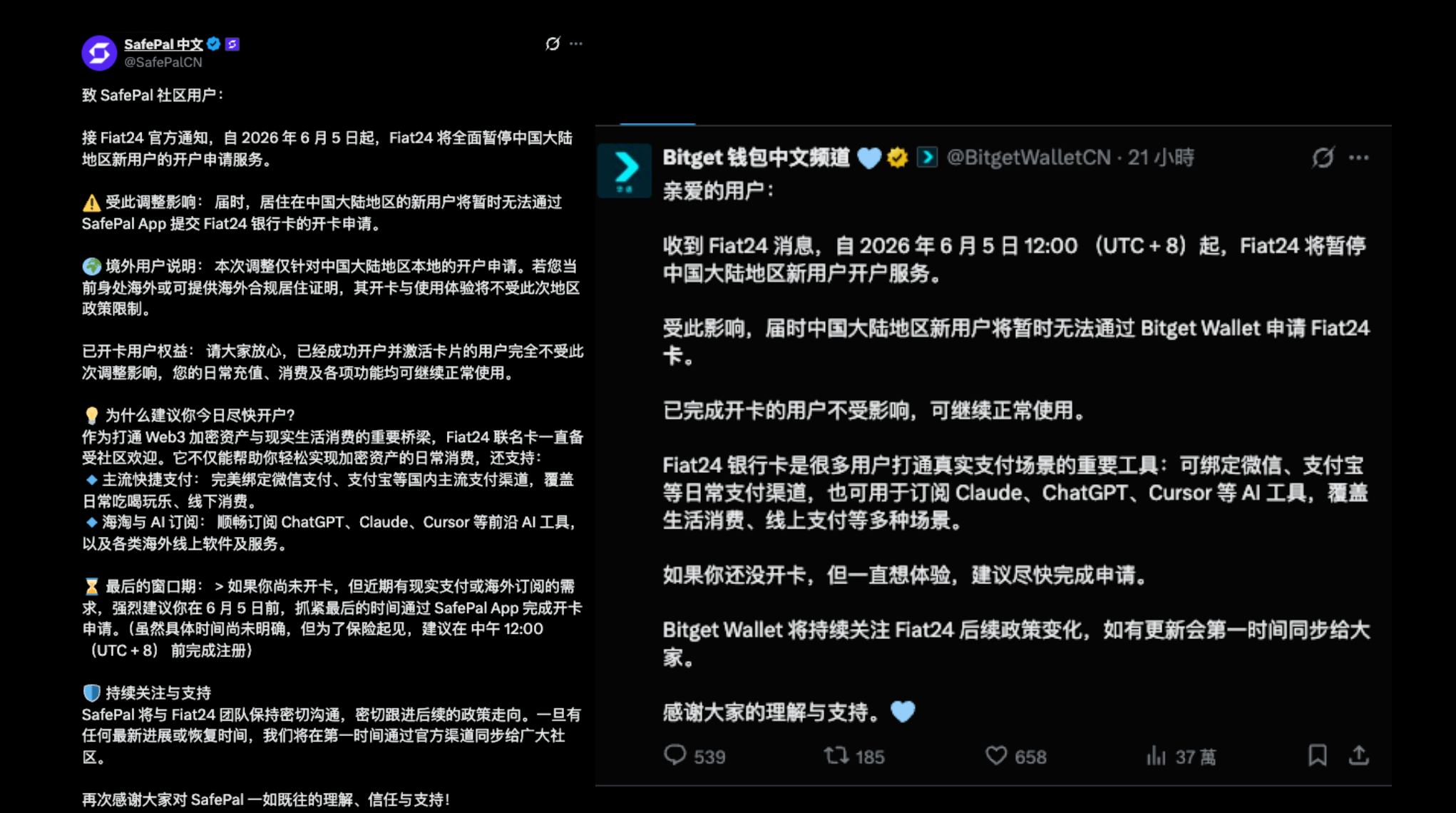
Crypto wallets SafePal and Bitget Wallet announced on June 4 that their U-Card programs received an official notice from Fiat24 stating that new user account applications from mainland China will be fully suspended starting June 5. Affected by this adjustment, new users residing in mainland China will temporarily be unable to submit applications for Fiat24 bank cards via the SafePal App.
It is reported that this adjustment only targets mainland China. New users currently overseas or able to provide valid overseas residency proof will not be affected in terms of card application and usage experience. The rights and interests of existing cardholders will remain unaffected; daily recharges, consumption, and all functions can continue to be used normally.
Fiat24 is a payment platform operated by Swiss fintech company SR Saphirstein AG, holding a Fintech license issued by FINMA (Swiss Financial Market Supervisory Authority) and built on Arbitrum Layer 2. After completing KYC, users obtain a real Swiss bank account (including IBAN), which can be linked to WeChat Pay and Alipay for domestic consumption, subscribe to overseas services like ChatGPT and Claude, and activate cross-border remittance channels such as Wise.
The realization of these benefits is one of the important financial channels for any long-term crypto holder, but this window has begun to narrow gradually against the current backdrop.
Currently, at least three mainstream wallet U-Cards—SafePal Card, Bitget Wallet Card, and imToken Card—are built on the Fiat24 infrastructure, sharing the same Swiss bank account system and KYC process. These three wallets chose to integrate with Fiat24 instead of issuing their own cards because Fiat24 provides banking licenses and compliance infrastructure that they cannot obtain on their own. Fiat24's suspension of mainland registrations also means the simultaneous closure of new user channels for all three platforms.
SafePal closed its ID card verification channel after January 23, 2026. In April, community feedback indicated that users who registered for U-Cards using passports last year generally received CRS reporting synchronization notices from Fiat24. The email mentioned that under the new regulatory requirements CRS/DAC8, all financial platforms need to collect users' tax residency information; failure to provide it may result in account restrictions.
What Should U-Card Users Do?
Existing Fiat24 cardholders do not need to panic for now. The SafePal announcement clearly states that users who have opened and activated their cards are not affected; recharges, consumption, and all functions can be used normally. However, temporary non-affectation and long-term security are two different things. From ID cards to passports, tax ID notices, and now suspension of registrations, Fiat24's restrictions on mainland users have been escalating. No one can guarantee that the next step will not affect existing users. It is recommended not to keep large amounts of funds in the card for a long time and to prepare a backup card as soon as possible.
Most of the remaining U-Cards on the market, whether issued by exchanges or independent projects, are prepaid card models: recharge crypto assets, convert to fiat currency limits, and use for card payments. They can meet daily payment needs such as subscribing to ChatGPT and linking to Alipay, but do not have bank account functions. For users with needs like cross-border receipt, SEPA transfer, and Wise deposit, Fiat24's suspension means the closure of a channel that is difficult to replace in the short term.
Regarding alternative options, the U-Card market is concentrating on exchanges. Some exchanges have their own payment card products; they do not profit from the cards themselves, as the profits from trading business are sufficient to cover the compliance and operational costs of card issuance, and the cards are tools for user retention. Some independent card-issuing projects are still operating, but they face the same pressures as OneKey and Infini. The information on which cards are available, specific KYC methods, fees, supported regions, etc., changes rapidly. It is recommended to directly check the official channels of each platform for the latest policies and not rely on third-party tutorials that may contain outdated information.
A Business with Every Link Taking a Cut
The U-Card users see is a simple product: recharge USDT, link to WeChat or Alipay, and consume directly. But behind this card is a long industrial chain. Users recharge stablecoins; the card issuer converts stablecoins to fiat via off-ramp service providers; payment networks (Visa or Mastercard) complete clearing with the card issuer and banks. Each link has independent participants, and each takes a cut from the process.
In this chain, upstream players like payment networks and banks truly hold the control. Card-issuing brands are at the end of the chain with the weakest bargaining power. The various U-Card brands users see often rely on the same batch of technology providers. These providers offer a "card issuance as a service" capability, including full infrastructure for transaction authorization, fund conversion, risk management, etc. Card issuers can launch a card by simply calling an API, making the threshold very low. However, this also means that card issuers have almost no control over the underlying operation of their products. If upstream technology providers or banks encounter problems, downstream card brands can only passively bear the consequences.
Costs are rigid: technical maintenance requires real-time transaction processing and security; customer service has to deal with various personalized scenarios such as refunds, recharge failures, and card binding issues. KYC and AML compliance audits are basic thresholds; for North American and European markets, registration with the U.S. FinCEN and EU MiCA regulations add further burdens. USDT is naturally associated with gray industry scenarios like money laundering and transaction volume boosting, so risk control pressure is far higher than ordinary payment products. For projects with teams working in China but registered overseas, China's policy attitude towards crypto currency poses additional legal risks.
Thin revenue, rigid costs, and uncontrollable upstream. These three factors combined determine that U-Card is an extremely fragile business. Any change in any link—whether upstream banks tightening cooperation, regulatory policy adjustments, or a money laundering case implicating a card issuer—can directly lead to business termination.
Multiple Players Collapsed in Two Years
Looking at the timeline, Fiat24 is just the latest one.
In September 2024, OneKey announced the suspension of new registrations and recharge functions, and officially stopped service on January 31, 2025. OneKey Card was among the earliest crypto payment cards for Chinese users, covering the Visa network and supporting Alipay binding. The official did not specify the reason for the shutdown, but the industry speculated it was related to the interruption of cooperation with upstream payment service providers.
In June 2025, Infini co-founder Christine announced on X the suspension of consumer-facing U-Card business. She believed that the to-C card business occupied 99% of the company's time and costs with almost no revenue contribution. All three product lines were suspended, and the company shifted to wealth management and B-side services.
In November 2025, crypto payment card provider Dupay issued a shutdown announcement stating that due to unsolvable compliance issues and capital circulation obstacles, it would officially terminate all services and shut down servers on November 30. The announcement mentioned that a previously frozen large sum of funds had not been unfrozen, and the relevant amount had been advanced by Dupay.
In June 2026, Fiat24 suspended new user registrations from mainland China.
A general risk control principle is not to put all your needs on one card. The past two years of the U-Card industry have proven that any player may suspend or shut down services in a short time. A combination of multiple cards, risk diversification, and using and leaving immediately are more realistic strategies in the current environment.