Long positions liquidated by $1.361 billion in 24 hours; options traders snap up short-to-medium term put protection; Fear & Greed Index falls into "Fear" territory, but far-dated options still bet on upside.
Written by: Sanqing, Foresight News
The crypto market is facing a deep correction.
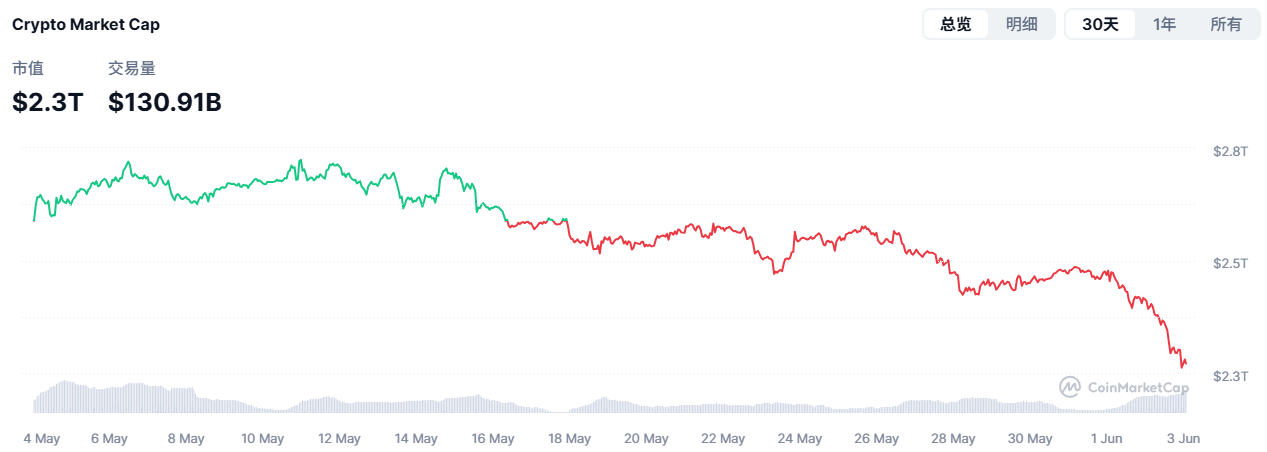
On June 3rd, Bitcoin was trading at around $66,458, plummeting 6% in the past 24 hours and once touching $66,186, hitting a new low in over two months; Ethereum fell even harder, currently at $1,867 with a 6.7% drop in 24 hours, once reaching $1,838, a new low in over three months. The total market capitalization of cryptocurrencies shrank by 4.82% in 24 hours, falling back to about $2.3 trillion.
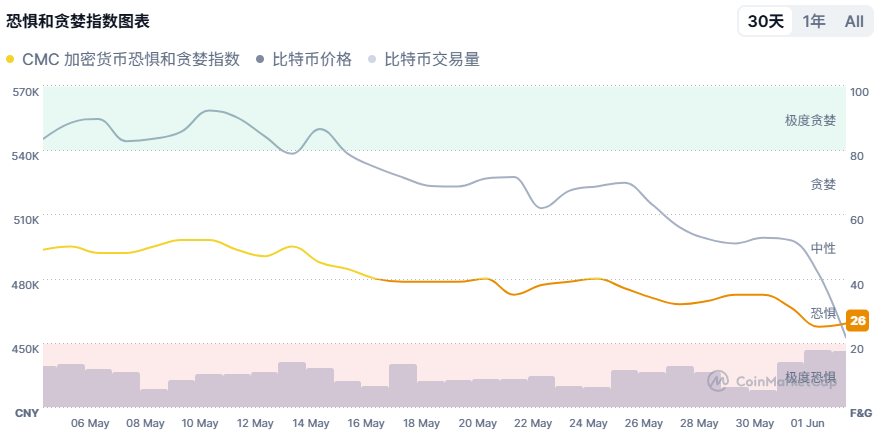
Sentiment has also turned cold. The CMC Crypto Fear & Greed Index dropped to around 26, entering the "Fear" zone.
The derivatives market is equally grim. According to CoinAnk data, the total liquidations across the network in the past 24 hours reached $1.515 billion, with long positions liquidated at $1.361 billion and short positions only $154 million. Long positions accounted for nearly 90%, a typical one-sided sell-off. By cryptocurrency: BTC liquidations were $736 million, ETH $349 million. The perpetual funding rate narrowed from 0.01% to around 0.0052% (MISSING). In Deribit contracts expiring on June 5th and 12th, put option positions between $66,000 and $68,000 were concentratedly increased on the breakout day, while the value of $70,000 call options became nearly worthless (mark price dropped by 70%–95%) (MISSING).
In terms of macro data: Brent crude oil rose slightly to $97/barrel (+2.48%) (MISSING); WTI crude oil was at $94.781/barrel (+3.24%) (MISSING). U.S. stocks: Dow Jones Index at 51,307.79 points (+0.45%) (MISSING); S&P 500 Index at 7,609.78 points (+0.13%) (MISSING); Nasdaq Composite Index at 27,093.90 points (+0.03%) (MISSING). Spot gold was at $4,481.5/ounce, up slightly by 0.13% (MISSING); silver at $74.8/ounce, basically flat.
Who is the Culprit Behind the Drop?
The first catalyst for this round of decline came from the "surrender" of Strategy, the market's biggest bull.
On June 1st, Strategy filed an 8-K with the SEC, disclosing that it sold 32 Bitcoins between May 26th and 31st at an average price of $77,135, totaling about $2.5 million. After the sale, the company still holds 843,706 BTC with a total cost of $63.87 billion and an average price of $75,699.
32 coins account for 0.004% of the company's total holdings (MISSING), and $2.5 million is equivalent to Strategy's average 1.5 days of purchases over the past 12 months. Financially speaking, this transaction is almost meaningless. But what it broke is far more significant than the amount it cashed out. Since its first Bitcoin purchase in August 2020, Strategy has only sold once: in December 2022, it sold 704 BTC for $11.8 million at an average price of $16,776 for tax-loss harvesting, and bought back 810 coins at a lower price two days later. That sale was essentially a tax maneuver, not a real reduction in holdings.
After the news was released, Strategy's stock price fell 10.2% intraday (MISSING), currently trading at around $134.5.
In addition, not only Strategy is reducing its Bitcoin holdings, but several institutions have also started to cut their Bitcoin positions. According to on-chain analyst Yu Jin's monitoring, crypto asset management firm Abraxas Capital sold 1,000 BTC ($67.49 million) during last night's decline, boosting the drop in BTC.
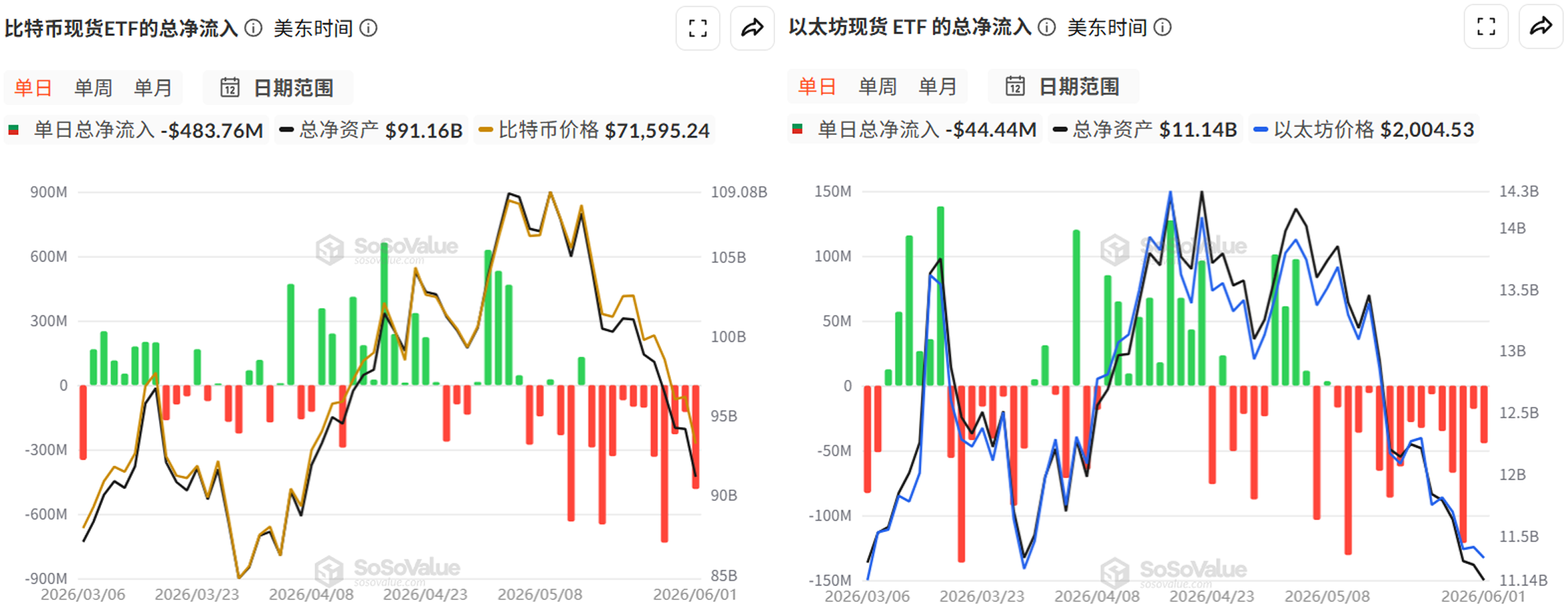
Furthermore, yesterday, wallets associated with Mt.Gox transferred approximately $739 million worth of BTC, which also increased market risk aversion. According to SoSoValue data, U.S. Bitcoin spot ETFs have seen net outflows for 11 consecutive days, and Ethereum spot ETFs for 15 consecutive days; in the past May, Bitcoin spot ETFs had a net outflow of $2.43 billion, setting the largest monthly outflow this year.
However, during the decline, Ethereum bull BitMine chose to continue increasing its holdings. According to on-chain analyst Yu Jin's monitoring, amid widespread institutional selling, BitMine increased its holdings of 25,000 ETH (about $47.98 million) via BitGo in the early morning.
The deepest drop on June 2nd was triggered by geopolitical tensions in the Middle East. Iran stated that it has stopped communicating with mediators, while the U.S. insisted that talks are still ongoing, and ceasefire negotiations have once again reached a stalemate. Meanwhile, Israeli military airstrikes on southern Lebanon killed 8 people and threatened further strikes on the southern suburbs of Beirut, leading to continued escalation of tensions on the Lebanon-Israel border.
Tensions related to the Strait of Hormuz have not eased either; Iran continues to impose controls on passing ships, and shipping risks remain high. Oil prices rebounded quickly due to war disturbances, with Brent crude once touching $98.3/barrel.
According to CCTV News, the U.S. Central Command posted on social media that Iran launched attacks across the Middle East on the 2nd, and U.S. forces intercepted several Iranian ballistic missiles and drones. In response, U.S. forces launched a "self-defensive" airstrike on Iran's Qeshm Island.
CCTV reported that the Islamic Revolutionary Guard Corps (IRGC) stated that the headquarters of the U.S. Fifth Fleet was attacked by missiles and drones from the IRGC's aerospace force.
However, the U.S. Central Command later posted again on social media, denying the IRGC's claim of attacking the U.S. Fifth Fleet headquarters and a U.S. airbase in the Middle East with missiles and drones, saying all Iranian attacks on U.S. forces failed.
What to Expect in the Future?
$65,000 is currently recognized as the critical line for bulls and bears, and the market has the biggest differences of opinion around it.
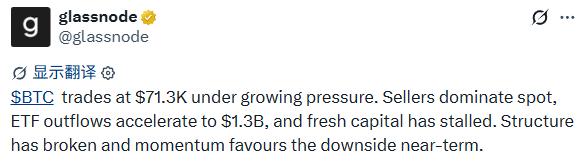
Glassnode stated on June 1st that the spot market is seller-dominated, ETF outflows accelerated to $1.3 billion, new capital inflows have stalled, the market structure has deteriorated, and short-term momentum is downward. Standard Chartered also maintains a cautious stance; it has previously lowered its 2026 target to around $100,000 multiple times and warned of the risk of testing lower levels in the short term.
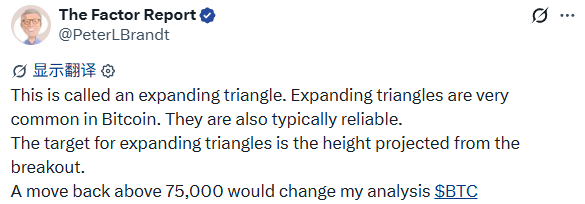
Peter Brandt believes that Bitcoin is currently in an expanding triangle pattern; until it reclaims $75,000, the pattern may continue to oscillate downward and test lower levels.
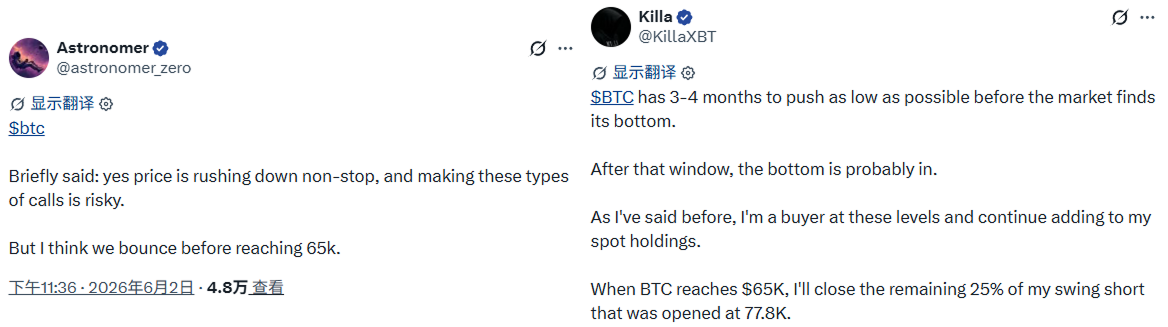
Cycle trader @astronomer_zero admitted: "It's risky to call a rebound in such a continuous decline, but I think the price will rebound before touching 65K." Quantitative trader @KillaXBT judges that BTC still has a 3-4 month window to bottom out, but has already bought at the current position and continues to increase spot holdings; he also said that when BTC touches 65K, he will close the remaining 25% of the swing short positions opened at 77.8K (MISSING). In other words, 65K is both a take-profit level for shorts and a medium-to-long-term accumulation zone in his eyes.