
First fusion: Crypto × AI tried to cram coins into AI; next fusion: AI makes crypto better.
Written by: Pink Brains
Translated by: AididiaoJP, Foresight News
Crypto venture capital is declining, talent is flowing to AI, and crypto KOLs are starting to post more AI content.
Is the crypto market doomed?
Crypto Market Is Losing Talent and Capital to AI
Crypto VCs' investment in crypto startups has cooled significantly—only about $5 billion in Q1 2026, compared to nearly $6 billion in the same period last year.
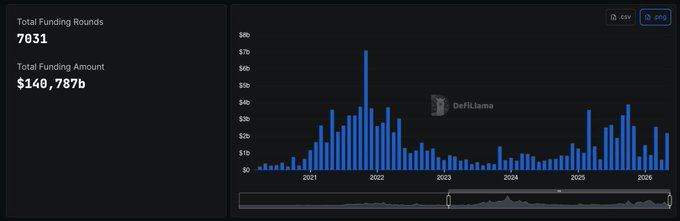
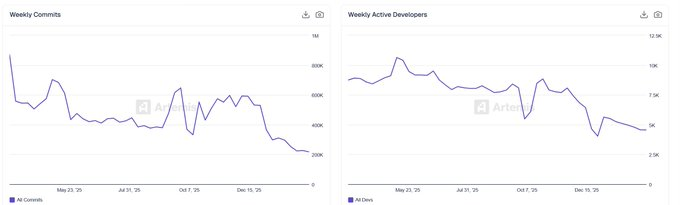
Builders are following the money. Electric Capital first noticed that active open-source developers dropped by 22% year-over-year, and by early 2026, the situation worsened—weekly submissions fell by about 75%, and the number of active developers on major chains halved; these talents directly migrated to the AI field.
AI, the "culprit" that siphoned crypto's resources, is now injecting new momentum back into crypto.
AI Needs Crypto
Crypto has so far produced only one product widely adopted globally without token incentives: stablecoins.
USDC settled $1.2 trillion in Q4 2025 alone, as it's faster and cheaper than traditional banking rails. Most other crypto products only circulate value among speculators.
AI breaks this pattern—it comes not as a narrative, but as real users.
Machine Money
What does AI need? Pay-per-action, instant, sub-second, human-intervention-free payments.
Why not Visa? Agents can't pass identity verification or hold bank accounts, but with crypto wallets, they can make payments.
Model Computing Power
What does AI need? GPU computing power that startups can afford, with no lock-in.
Why not AWS? Hyperscale cloud services are priced for enterprises, while decentralized supply can be 60-86% cheaper.
Privacy-Preserving and Verifiable Infrastructure
What does AI need? Running prompts without being read, recorded, or used for training by any provider (on-chain private inference).
It needs a place to host agents and privately transfer value between chains (agent economy). It also needs verifiable and unique identities for agents (agent identity).
Why not OpenRouter or Alibaba Cloud? The business model of centralized AI is "looking at your data". Centralized providers are takers—no revenue sharing, no user segmentation. The Crypto×AI track can provide access without these issues and align user incentives.
Why not other Web2 platforms? Confidential but verifiable settlement, verifiable and unique agent identities—these are blockchain-native features; elsewhere, they can only be added later.
Financial Markets
What does AI need? Speculation and attention. Like any other industry, AI is speculative for traders. Crypto unlocks new ways to expose oneself to or participate in this trend.
Why not TradFi? AI stocks, pre-IPO AI companies, prediction markets, permissionless 24/7 perpetual trading for GPU and robot capital markets, agent job markets, etc. TradFi is simply not fast or open enough to meet the needs of new finance.
Crypto Is AI's Use Case
CT (Crypto Twitter) has been looking for new crypto narratives. The truth is, crypto has matured. We've spent years moving most existing financial tools on-chain; today, 0-to-1 breakthroughs in the crypto market are very rare.
Just like other industries—finance, marketing, legal services, healthcare, academic research, software engineering... AI is changing how we interact with crypto.
Crypto has a steep learning curve. Explaining AMM pools, cross-chain bridges, how/where to earn yields with stablecoins to non-crypto natives is extremely difficult. In trading venues, ordinary people can hardly beat machines.
The core idea: If AI can make crypto more useful and profitable, more people will return to crypto.
On-Chain Agent Analysts
Hermes is an open-source AI agent launched by @NousResearch; it learns while working. It has memory, can create reusable skills, and gets smarter over time.
You can use it as a personal on-chain analyst: connect data sources like X, Reddit, wallets, portfolios. It researches the market daily, tracks your positions, and finds opportunities based on your strategy and risk preferences.
AI-Driven Prediction Markets
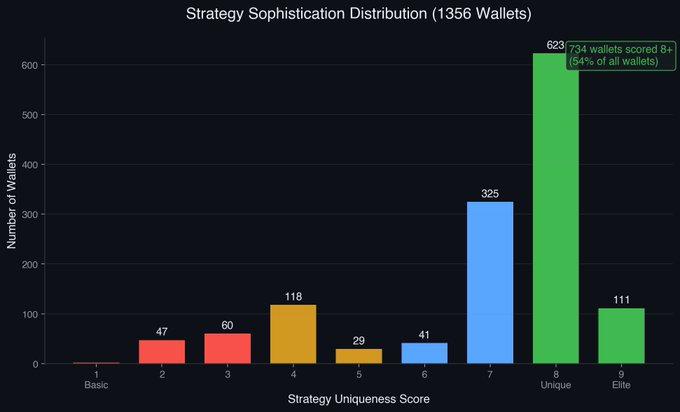
Retail investors are being completely crushed on @Polymarket. Median power users on Polymarket now run complex automated strategies, likely driven by AI behind the scenes.
The competition threshold for prediction markets has risen sharply.
- @Chance_: An AI+ liquidity layer for prediction markets (Kalshi and Polymarket). It integrates major platforms into one place, allowing users to build and deploy agent-based betting strategies from a single platform.
- @0xbeepit: Packages prediction markets into a swipeable feed, offering two modes—manual betting or letting an always-online AI agent handle it. It trades 24/7 within your set funds and limits, while you retain full control.
- @momus_ai (built on @openservai) is an AI agent that trades prediction markets while fully disclosing its reasoning process; users can audit the reasons behind each of its decisions.
AI Trading
AI can outperform humans in trading because it doesn't sleep, panic, revenge trade, or miss information. It can monitor thousands of wallets, narratives, charts, news events, and on-chain signals simultaneously, then execute instantly based on data rather than emotion.
But AI isn't invincible. Most models are trained on historical patterns and may fail badly in black swan events, sudden market structure changes, new vulnerabilities, or unexpected regulatory shocks.
Nevertheless, AI trading remains a core use case for crypto.
@liquidtrading (@coinvestai) launched Co-Invest: an AI connector that lets you fund your account and execute real trades directly in ChatGPT and Claude. It covers 500+ markets (crypto, stocks, forex, Polymarket, pre-IPO secondary shares), is non-custodial, routes orders via Hyperliquid, Lighter, and Ostium, and requires just a tap to confirm each trade. Since August 2025, Liquid has processed over $3 billion in trading volume and served ~40,000 users.
@Chain_GPT (a crypto AI infrastructure provider) launched an AI skill for Claude Code, with a built-in full crypto development and trading terminal environment. After installing this skill, agents gain built-in wallets for 33+ chains and can directly swap and trade on Hyperliquid.
@senpi_ai: The first personal AI trading agent built for Hyperliquid. Non-custodial, supports OpenClaw, runs via Telegram. It has 31 built-in dedicated trading tools and persistent memory, can learn your risk preferences, and gradually upgrade from co-pilot suggestions to fully autonomous strategies.
@FractionAI_xyz Index: Turns your trading ideas directly into real-time perpetual trading agents. It goes a step further: first backtests your idea on historical data, optimizes it in an experimental loop, then deploys it as a real-time perpetual agent.
Humans are no longer the best executioners, but they are still the best strategists. We don't need to argue about who is better at trading—humans vs AI. The future is humans guiding, tuning, and deploying AI agents to execute market theses faster and better.
To learn how to use AI to improve trading, recommend reading @cyrilXBT: Connect Obsidian (a local note-taking app) with AI—every trade record is fed into the system, allowing it to mine your repeating patterns and continuously optimize feedback.
AI Makes DeFi Simpler
MCP connects AI tools with crypto apps. @base just launched Base MCP, allowing users to link their Base accounts to AI clients (ChatGPT, Claude, Cursor, Hermes). This means AI agents can directly swap tokens, transfer funds, check balances, read wallet history, and interact with DeFi via chat prompts. The initial skill set is limited, but anyone can build and add more skills, opening the door to countless new use cases.
@byreal_io (incubated by Bybit) is an AI-native DEX that launched its own agent: RealClaw. Everything is packaged as OpenClaw skills, which any agent can install and interact with autonomously. Using simple chat prompts on Telegram, the agent can:
- Copy top arbitrage strategies
- Analyze LP pools and APR
- Discover tokens and prices
- Execute swaps with quote previews
- Open, manage, and close CLMM positions
- Track wallet balances
- Auto-farm xStocks points
AI Becomes a New Revenue Source for Crypto Builders
Most crypto protocols have struggled with sustainability.
The tokenomics flywheel looks great in a bull market: surging trading volume, tokens pumping everywhere, high yields, airdrops continuously attracting users, everyone is optimistic.
But in the end, fundamentals matter. Protocols need real revenue streams to survive or support their tokens.
AI is starting to become a new growth engine for crypto apps.
If AI can help builders earn more revenue, builders will stay in crypto.
On-chain inference is where demand is most quantifiable, as the unit is "tokens served" rather than "tokens traded."
@AskVenice (the fastest-growing censorship-resistant, privacy-first provider) serves 50-80 billion tokens daily, recently hitting an all-time high of 80 billion, with an estimated ARR of ~$12-14 million.
@chutes_ai (a fully decentralized serverless inference network on Bittensor) is in the same league (7-day average ~55 billion), with an estimated ARR of nearly $6 million, 400k+ users, and is Bittensor's first subnet with a token market cap exceeding $100 million.
Agent and agent economies are where agents can truly make money.
@virtuals_io runs the largest on-chain agent economy: 39,000+ agents, ~$4 million in agent-to-agent revenue, 2.2 million+ tasks completed. The protocol's cumulative revenue is currently ~$70 million.
AI's DePIN is where real demand and token subsidies coexist.
- @grass: Annual revenue ~$33 million (selling training data to AI labs), scraping ~90TB of data daily across 8.5 million nodes, with a market cap/revenue multiple of ~21x.
- @rendernetwork: Annual revenue ~$2.7 million, market cap ~$878 million; $RENDER burn volume +158% YoY. H100 on decentralized supply is still 18-30x cheaper than AWS.
- @akashnet: ARR ~$4.2 million, with the best unit economics in its category. AkashML now offers OpenAI-compatible APIs, covering ~65 data centers.
- @opentensor: The network generated $43 million in revenue from real AI usage in Q1, supported by an ecosystem of 70+ active nodes. Bittensor's revenue doesn't come from a single product but from specific services provided by each subnet (API calls, computing power, etc.). @TargonCompute (Subnet 4) contributes over $10 million annually, and @chutes_ai (Subnet 64) generates ~$5.5 million annually from paid API calls.
Trading fees are crypto's oldest business model—now pointing to AI as the underlying layer.
@NEARProtocol's NEAR Intents has processed a cumulative $19 billion in trading volume, generating $32 million in fees, of which ~$3 million monthly is used for $NEAR buybacks. The protocol defines this primitive as a transaction type for AI agents, services, and end users.
Hyperliquid isn't an AI protocol itself, but it's heavily monetizing the AI narrative. The HIP-3 market charges twice the normal perpetual rate, split 50/50 between deployers and the protocol. Its AI sector includes pre-IPO perpetuals for OpenAI, Anthropic, SpaceX, and Cerebras. These 5 tickers generated ~$19 billion in trading volume in 6 months, reaching $16 billion in May 2026 alone as IPO speculation heats up.
Crypto × AI or AI × Crypto?
AI and crypto need each other.
AI brings real demand to crypto by making it more efficient for users.
Crypto provides AI with what centralized systems can't: community-owned resources, transparent verification, and permissionless access.
AI in crypto and finance isn't a shortcut game. The real dividends will go to apps that can turn complex reasoning and setups into simple, secure, user-friendly products while continuously iterating with better models and smarter strategies.
@jonah_b points out that AI agents may break the "Fat App" argument. Agents don't care about brands, UX, or loyalty—they go straight to APIs and switch to the best option instantly. When machines become users, the moat of having a frontend will weaken significantly.
You have reason to be skeptical now, but don't miss out
The current Crypto × AI hype is much like the 2020 DeFi Summer: fast launches, constant go-lives, capital rotating everywhere.
But most projects are still driven by speculation and incentives. When emissions slow or token prices drop, sentiment will fade. Only a few projects will truly break through and find PMF.
Yes, AI can succeed without crypto. But crypto and AI also have strong synergies: talent, distribution, community, open infrastructure. If done right, users will benefit from both—not just financially, but through better products and experiences.
The first wave of Crypto × AI tried to cram coins into AI; the next wave is AI making crypto better.