
For the first time, DeFi is handling insolvency like an investment bank—allocating losses according to contract terms instead of community votes.
Author: Sanqing, Foresight News
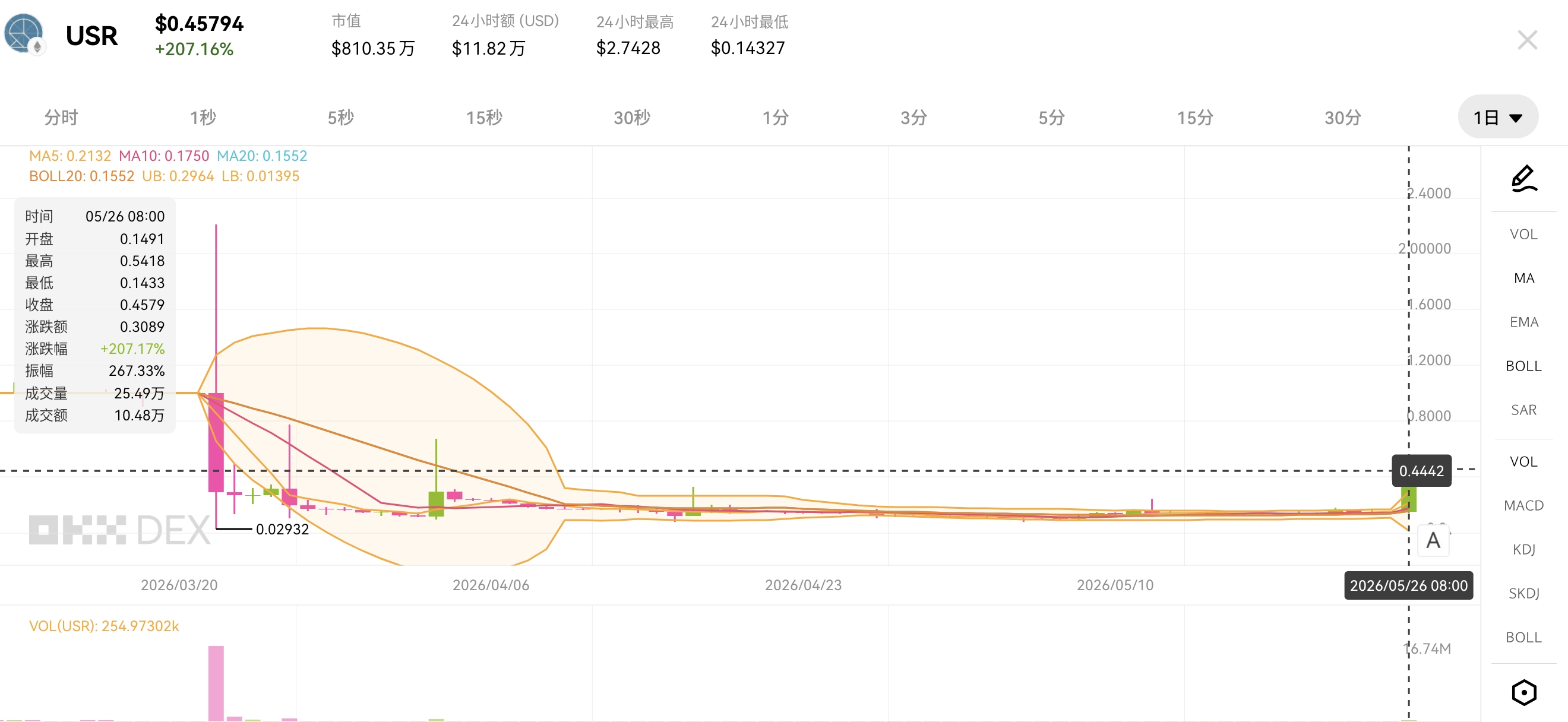
On May 27, the Resolv Foundation released its first complete recovery plan post-incident, exactly two months after the event. Earlier, on March 22, an attacker exploited an AWS KMS environment vulnerability to access Resolv’s minting key, using approximately $200,000 USDC to mint 80 million uncollateralized USR tokens, which were then exchanged for around $25 million ETH and transferred out. USR once fell below $0.03, and the protocol entered a suspended state.
The announcement categorizes affected users into six groups. The claim window closes on August 26, with no claims accepted after the deadline. USR quickly rebounded from $0.14 to around $0.45 after the announcement was released.
Contract Terms Replace Community Voting
The most critical line in the announcement defines USR as senior tranche and RLP as junior tranche, citing Clause 4.3 of the Terms of Service. By design, RLP was always meant to absorb losses before USR.
This clause was downplayed when the incident occurred, but it is now re-invoked as the legal basis for the entire payout framework.
Most previous DeFi incident resolutions relied on governance votes or foundation bailouts, which are essentially post-hoc negotiations. Resolv’s approach this time is different: instead of letting the community vote on loss allocation, it directly references the existing tiered structure in the product terms to precisely assign losses to each group of holders.
This is a creditor liquidation schedule executed in senior/junior order.
This terminology comes from collateralized debt obligations (CDOs), asset securitization, and Chapter 11 reorganization processes under U.S. bankruptcy law.
RLP: Named "Insurance", Actually "Cannon Fodder"
Drawing a line between "pre-incident holders" and "post-incident buyers" via snapshots and applying different payout coefficients is relatively rare in DeFi rescue efforts.
The first category is direct holders of USR and wstUSR, split into two groups via snapshot. Pre-incident holders are treated as senior creditors and receive full 1:1 USDC payout; post-incident buyers, due to mixing with illegally minted supply, receive a uniform 1:0.5 write-down payout regardless of their cost.
For post-incident buyers, any purchase price below $0.5 USDC counts as a successful bottom-fishing.
The second category is USR-related LP liquidity positions, with more complex handling logic. Resolv breaks down each LP position into USR components and paired assets: pre-incident position parts get a 1:1 payout, while rebalanced parts due to hacker sell-offs get a 1:0.5 payout.
Regular LP providers receive about 75% cash payout plus RESOLV token compensation, which the official claims can raise the total payout rate to around 95% of the initial position. However, the actual payout rate for leveraged LP positions after debt deduction will be significantly lower than that of regular LPs.
The third category, the most controversial, is RLP holders. As the protocol’s "cannon fodder", each token only gets a $0.71 USDC payout, with the reference price reset to 55% of the pre-incident level. RLP holders get an additional 2.71 RESOLV tokens per RLP held, which the official says can boost the comprehensive payout rate for RLP to over 60%.
However, the plan clearly states that any RLP position liquidated due to leverage will receive no payout, meaning large leveraged RLP holders like Stream Finance face total loss.
The fourth category covers participants in lending markets. Users who provided USR collateral on platforms like Morpho or Fluid have creditor status equivalent to pre-incident holders and enjoy a 1:1 payout.
Users who provided USDC or USDT, as they are not directly exposed to the USR collateral pool, will not receive direct payouts from Resolv; loss recovery depends on the interacting protocol or vault manager.
The fifth category is USR Yield Maxi vault users, who will receive a payout equal to 90% of the pre-incident share price; the sixth category is PT and YT positions on Pendle, which, after conversion to wstUSR, also get a 1:1 payout based on system token (SY) value.
Old Debts Unsettled, New Business Line Launched
The second half of the announcement introduces a new business line: Vault Street. Managed by the Resolv Foundation, it is positioned as an institutional distribution platform for tokenized real-world assets. The first product, primeUSD, is in private testing and will launch publicly in June, targeting institutional vaults and large capital pools with permissioned leveraged tokenized U.S. Treasury exposure.
The Resolv team’s TradFi background is fully reflected in this business line. Structured products, leveraged financing, securitization—these labels were already on the team’s resume, and the incident handling method just laid this foundation bare.
The RESOLV token functions remain unchanged; staking and unstaking resumed on May 26, with 300,000 RESOLV rewards to be distributed over the next two weeks. The foundation’s arrangements indicate that the old business line is entering the final stages of liquidation, while the new one is launching.
The 60% payout rate stated in the announcement is based on a RESOLV token reference price of $0.03. This is a guarantee using tokens instead of cash. To fill the cash payout gap, Resolv commits to allocate 10% of the total token supply as compensation, 70% of which goes to affected RLP holders.
According to Bitget market data, RESOLV token has fallen over 22% in the past 30 days, trading at around $0.023 at press time—already below the reference price set in the announcement. Coupled with over 10,000 tokens subject to 24-month linear unlocking, RLP holders’ payouts have shrunk significantly, and they will continue to bear the token’s downside risk for the next two years.
Using tokens to fill the cash payout gap essentially transfers the foundation’s funding pressure to the victims’ market risk.