
What does the world need now? The answer doesn't necessarily include Ethereum itself.
Compiled by: Foresight News
On April 20th, the ETH HK Community Hub, co-operated by SNZ and ETHTAO, was officially launched in Hong Kong. Ethereum founder Vitalik Buterin and Duncan Chiu, Member of the Legislative Council of the Hong Kong Special Administrative Region (Technology and Innovation Sector), held a fireside chat at the launch event. The topics ranged from Vitalik's 12-year connection with the Chinese-speaking community to the latest Ethereum roadmap, L2 development, quantum resistance and AI, as well as his expectations for the ETH HK Hub. Below is the full transcript of the dialogue, edited and compiled by Foresight News.
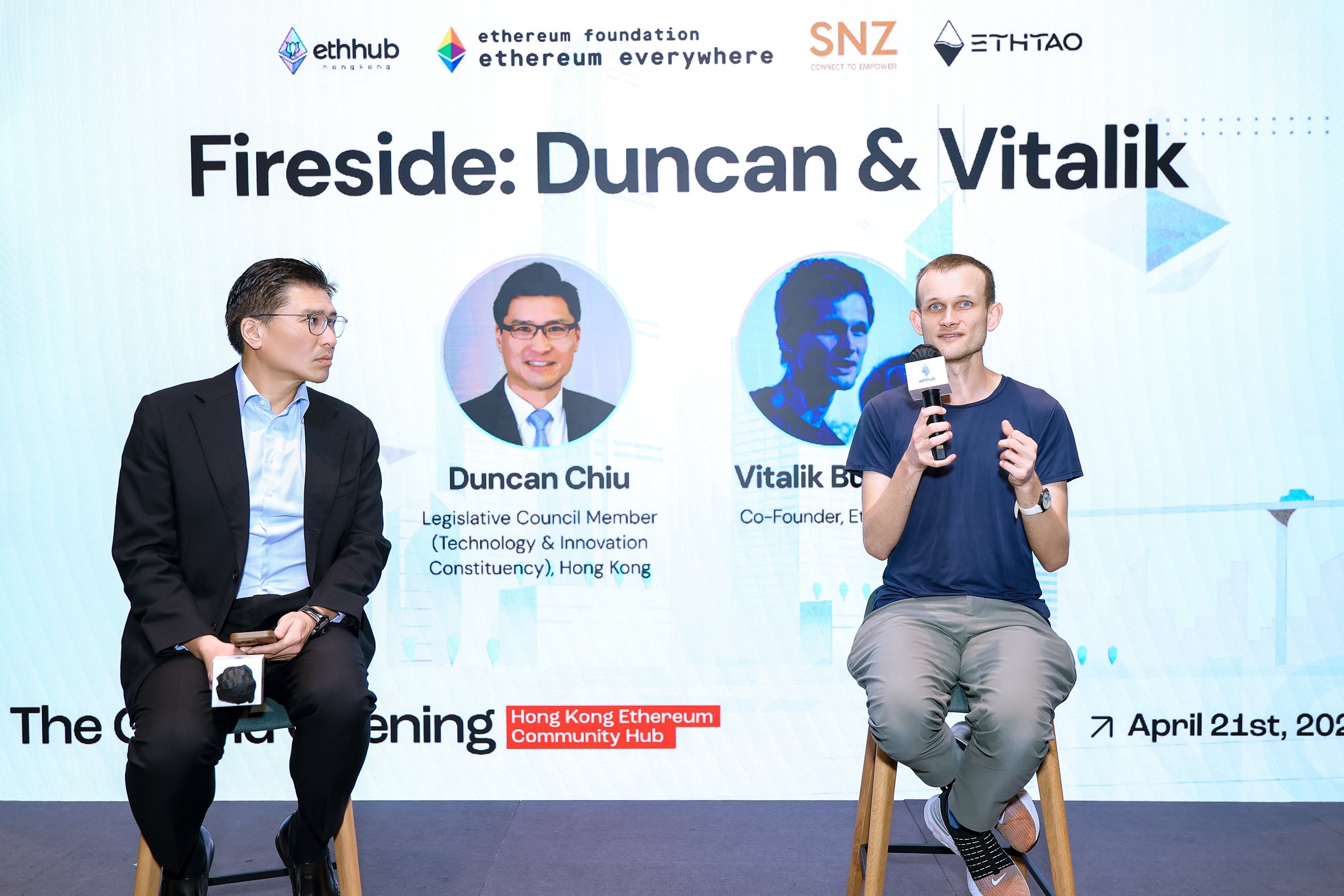
1. Historical Connection with the Chinese-speaking Community
Duncan Chiu: Let's start from 2014 when you launched Ethereum. Over the past decade or so, you've spent a lot of time in the Chinese-speaking community, developing in places like mainland China and Hong Kong. Can you share your journey of thoughts and feelings with the Chinese-speaking community and friends here? How do you look back on this journey?
Vitalik: I first heard about the Chinese community in 2013. At that time, there weren't many ICOs yet, but mining and exchanges were already very active. I was curious, so I came to China for the first time in May 2014, visiting Beijing, Shanghai, Hangzhou, and Shenzhen, and saw many large offices here. Back then, Huobi's office already had hundreds of people, while U.S. exchanges like Coinbase and Kraken hadn't reached 100 people yet.
When I came again in 2015, I saw that there were some very early smart contract platforms in China exploring this area. However, their design approach was different from Ethereum's—they let each application build its own chain and tokens circulate between them; while Ethereum places applications on the same chain, keeping them independent of each other.
The Chinese ecosystem has changed a lot over the years. I've noticed that many Builders in the Chinese-speaking community now seem to have completely forgotten the period before the pandemic—though it's only been two or three years, it feels like a different era.
A major change is ZK. When a new technology emerges, it gives the new generation a great opportunity—developers who just started working with ZK this year can also become top in this field. Since 2022, many new brands and teams have emerged in ZK, L2, and DeFi.
However, I want to say that core protocol development and L2 development are of completely different difficulty levels. L2 is more like a "free market" design: if you are an outsider and not in the core community, as long as what you do is good, you can still win. But core protocol is different— to participate in this process, you have to coordinate with existing developers—for example, changing a gas limit is a huge task—so sometimes it's even harder.
2. About L2: Can't Just Be a Copy of L1
Duncan Chiu: There have been many version upgrades over the past decade, like the "Shanghai" upgrade, which is also a kind of nostalgia for China for you. You've been emphasizing recently that L2 can't just be about scaling—what do you think about this?
Vitalik: L2 is still very important now. But I think a good L2 can't be a copy of L1. L2 should be complementary to L1, not overlapping.
Nowadays, many applications need blockchain, but at the same time, they also need things beyond blockchain—like very high throughput, certain privacy capabilities, etc. The pure EVM L1 form is not actually the most ideal direction. So you'll see that many L2 ecosystems now start to include parts that don't require EVM.
In other words: the purpose of building an L2 shouldn't be to build an L2 "just for the sake of building an L2"; it should meet the needs that L1 can't fulfill but are critical for certain applications.
3. Latest Roadmap: Data Scaling and Compute Scaling
Duncan Chiu: You recently released a new roadmap, dividing it into short-term, medium-term, and long-term. Can you tell us more about the short-term data scaling and compute scaling in it?
Vitalik: L1 scaling is still very important. We do find that many applications can theoretically move more parts to L2—but if we really do that, your application will need more intermediaries, and each user will have to trust more companies that may have problems. So L1 itself can't be completely replaced by L2.
Specifically for data scaling, Ethereum's data layer is currently only 25% actually used. We still have many ways to push this ratio higher when scaling is really needed.
But data isn't the only problem. You can build an application that lets people put their data on it, but how do others know what those data mean? There will always be a need for a computation process in the end. You can say "let this computation happen off-chain", but then each application will have its own independent computation, leading to compatibility and composability issues—applications will find it hard to interact with each other. So we still need Ethereum to provide a native settlement layer.
Of course, there are many challenges here. A scalable ERC-20 token will be quite different from the ERC-20 we use now—application developers will also need to make some adaptations.
4. The Past of DoS Attacks: Why Move Towards More Lean Clients
Vitalik: You may remember that about ten years ago, around the time of Devcon in Shanghai, Ethereum experienced a very complex DoS (Denial of Service) attack. It took my team and me about 3 hours to figure out the principle of the attack, and we released a client patch around 8:30 or 8:40 in the morning. We saw the chain quickly recover, and the conference started on time—we all thought it was over.
But then a second attack happened two days later, and a third one after some time. Someone tried every possible exploit point in the two clients one by one. We barely slept for those two months.
So we hope that future clients will be safer and more lean. This is one of the motivations behind the current Lean Consensus direction—we don't want any hidden bugs in the clients to cause us such pain again in two or three years.
5. AI and Quantum Resistance: Solvable, But Need to Do It Seriously
Duncan Chiu: You've also mentioned AI and quantum many times recently. There are many different opinions in the media about which is more vulnerable—Bitcoin or Ethereum. What do you think about the intersection of these two directions with Ethereum?
Vitalik: In Ethereum, both of these problems are completely acceptable and solvable, but they require quite a bit of effort to handle. Let me give a non-technical analogy—imagine a country where people have never heard of "rain". Their houses are completely not designed to be rainproof. When it rains for the first time, about 5% of the houses will leak. But they won't be anxious either, because they've never seen rain and don't know what "rain" means at all.
Then, one day they are told: it will start raining in five or ten years. At that time, they need to learn to build rainproof houses, rainproof schools, rainproof offices—replace the entire social infrastructure.
Quantum resistance is such a thing for the Ethereum ecosystem. It will happen in the next three to five years.
We actually already know how to do quantum-resistant cryptography. I wrote a quantum-resistant signature five years ago; in 2017, I also wrote a smart contract for a hash-based signature algorithm. We know how to do all these things. Why haven't we implemented them yet? Because they are less efficient— a hash-based signature is about 2300 bytes, while the current elliptic curve signature is only 64 bytes. You can't put every signature directly into the block; the efficiency will be too low.
The solution is aggregation: the block-producing nodes package all users' signatures and use a STARK to prove the existence of these signatures. ZK tools in this direction are already taking shape.
Duncan Chiu: If these solutions are added, will there be an impact on gas?
Vitalik: By default, gas will be higher. The gas for a transaction may increase from 20,000 to 200,000. So our plan is roughly like this: the block-producing nodes will combine all the signatures sent by users in a block into a single STARK proof.
For example: suppose there are 10 million users, each sending a transaction with a signature of about 3000 bytes—total is about 3 MB; but through STARK, it can be compressed into a 128 KB or 256 KB proof. This is the direction we will promote next.
6. Expectations for the Chinese-speaking Community and ETH HK Community Hub
Duncan Chiu: Today is a special day for the official opening of the ETH HK Community Hub. Do you have any expectations for the Builders of the Chinese-speaking community and this Hub?
Vitalik: There are a lot of things to do in the current ecosystem. I think the past two years are an opportunity to rebuild many things.
Now ordinary developers can also do things that they couldn't do before. The world is also becoming more and more complex, so there are many ways to participate.
I encourage everyone to think: what does the world need now? The answer doesn't necessarily include only Ethereum—it could also be Ethereum plus other things. For example, next to the Ethereum ecosystem, there are a lot of open-source hardware in Shenzhen, various kinds of AI, including AI specifically for music. These directions can be combined by Builders to create new things.
So I hope everyone can start doing more projects that are completely different from Ethereum three years ago.
(The above content is compiled from the on-site recording of the ETH HK Community Hub launch event, with slight edits.)