
Currently, Santurn has launched its points program.
Written by: Grok
Edited by: Ma He, Foresight News
On April 9th, DeFi yield protocol Saturn officially launched its mainnet, marking the end of its private testing phase. Institutions including Flowdesk and Galaxy collectively deposited $10 million during the private test. Within 24 hours of the mainnet launch, the protocol's Total Value Locked (TVL) quickly exceeded $40 million.
As of April 17th, the latest data shows its TVL stands at $72.6 million.
USDat is a non-yield stablecoin, 100% backed by tokenized U.S. Treasuries, issued based on M0 infrastructure, and primarily used for payments, settlements, and DeFi liquidity provision.
Saturn is developed by Saturn Labs, with its core product being a dual-token stablecoin system: USDat and sUSDat.
sUSDat is the staked version of USDat, 100% exposed to Strategy's STRC digital credit product (an institutional-grade preferred equity instrument collateralized by Bitcoin), currently offering an annualized return of approximately 10%.
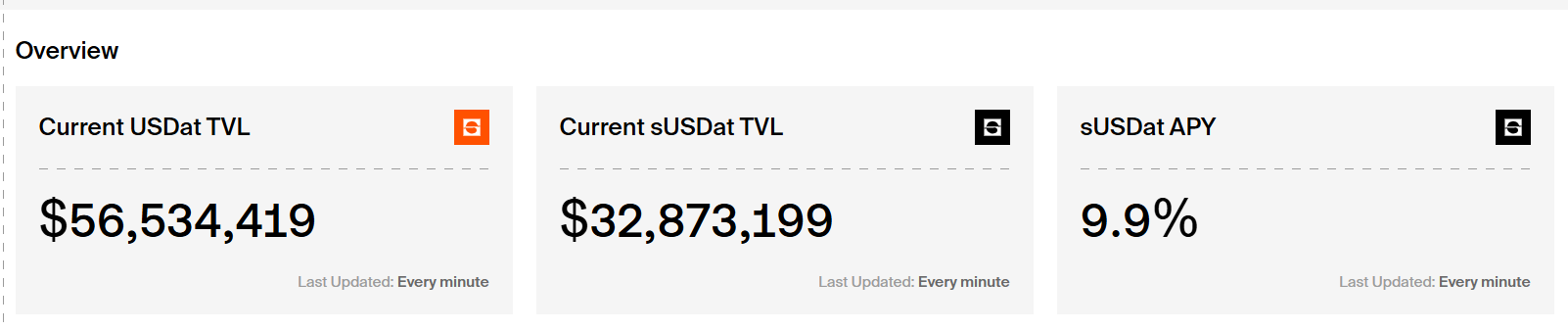
This dual-token design separates liquidity and yield; users can exchange assets like USDC for USDat, then stake it to get sUSDat and earn returns backed by Bitcoin credit.
Currently, sUSDat supports Pendle's fixed/floating rate strategies and was launched on Morpho on April 16, 2026, allowing sUSDat to be used as collateral or lending liquidity with an initial borrowing limit of $10 million.

Saturn's yield comes from Strategy's Bitcoin credit strategy. Strategy's STRC product is a perpetual preferred equity structure, distributing approximately 11.5% annualized dividends monthly, backed by a Bitcoin balance sheet.
Saturn tokenizes this institutional-grade credit product and integrates it into DeFi, allowing users to earn related returns on-chain without directly holding stocks. USDat's reserves are 100% tokenized U.S. Treasuries, while sUSDat fully corresponds to STRC collateral; dividend inflows directly boost the exchange rate of sUSDat to USDat.
Operational Mechanism
Saturn's dual-token model aims to resolve the conflict between traditional stablecoins' zero yield and the high threshold of institutional credit products. As the base stablecoin, USDat is pegged to the U.S. dollar and maintains 1:1 redemption, achieving compliant issuance and transparent reserves mainly through infrastructure like M0.
sUSDat represents the on-chain target of STRC: users receive sUSDat after staking USDat, and the price of sUSDat naturally rises with the accumulation of STRC interest, equivalent to an on-chain "yield-bearing dollar". This mechanism does not rely on algorithms or fluctuating over-collateralization; instead, it directly connects to Strategy's public digital credit product, with relatively transparent yield sources.
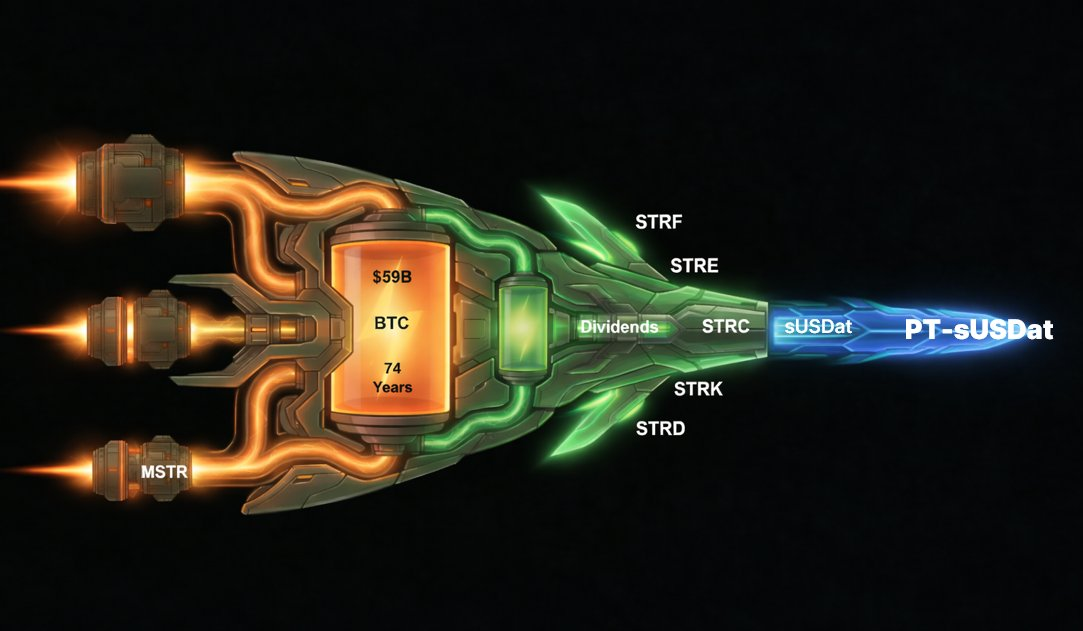
The project has deeply integrated with DeFi platforms like Pendle and Morpho. Pendle users can trade fixed/floating rate derivatives of USDat/sUSDat; the Morpho market allows sUSDat to be used as collateral for leverage strategies, with initial liquidity support from Flowdesk.
From a risk perspective, Saturn's yield is directly linked to Strategy's Bitcoin holdings and STRC performance. If Bitcoin prices fluctuate significantly or Strategy adjusts its dividend policy, the yield of sUSDat will face uncertainty. Additionally, the compliance of Real-World Assets (RWA), reserve audits, and changes in the regulatory environment remain key market concerns.
Points Program
According to official documents, the first season focuses on liquidity incentives, including Curve, Pendle LP, and Morpho supply activities; participants can earn points by holding or providing liquidity. Unstaking sUSDat takes 3-7 days to process to maintain market stability.
The announced weights include: holding USDat or sUSDat to get base points; exchanging USDC for USDat via Curve to get 7x points; providing liquidity for the USDat/USDC trading pair to get up to 20x points.
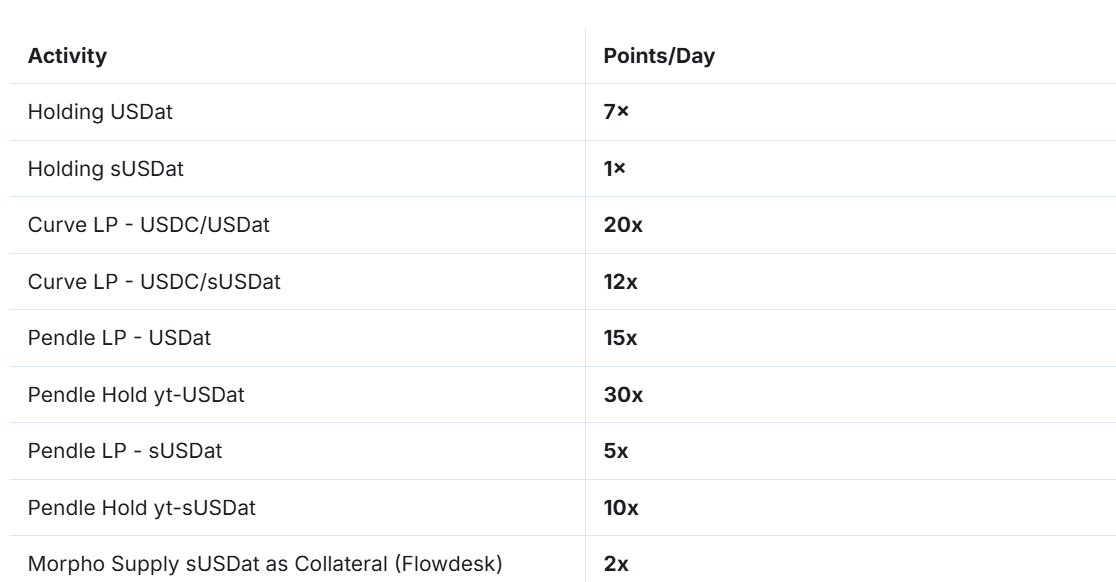
The first season will end when Saturn's TVL reaches $500 million or on August 8, 2026, whichever comes first.
The official stated that the program's points will serve as an important reference for potential future token airdrops or reward distributions. However, Saturn mentioned in its disclaimer that incentives for the first season may change, and all adjustments will remain transparent.
Team Background
Saturn Labs is co-led by Kevin Li (co-founder and CEO) and Ellis Osborn (co-founder and COO). Kevin Li previously worked at ParaFi Capital and Artemis, and holds a master's degree from the University of Pennsylvania. Ellis Osborn previously worked at M31 Capital and also graduated from the University of Pennsylvania. Their CTO Seb was previously the stablecoin lead at Artemis.

Kevin Li
Kevin Li has repeatedly elaborated on the logic of bringing Strategy STRC on-chain in public discussions, emphasizing the integration potential of "digital credit" and DeFi. The project is incubated by YZi Labs, which has supported early Web3 projects through EASY Residency.
Official information shows that the team is registered in the British Virgin Islands.
In January 2026, Saturn completed an $800,000 seed round financing, led by YZi Labs (EASY Residency Season 2) and Sora Ventures, with participation from several well-known angel investors in the crypto space.
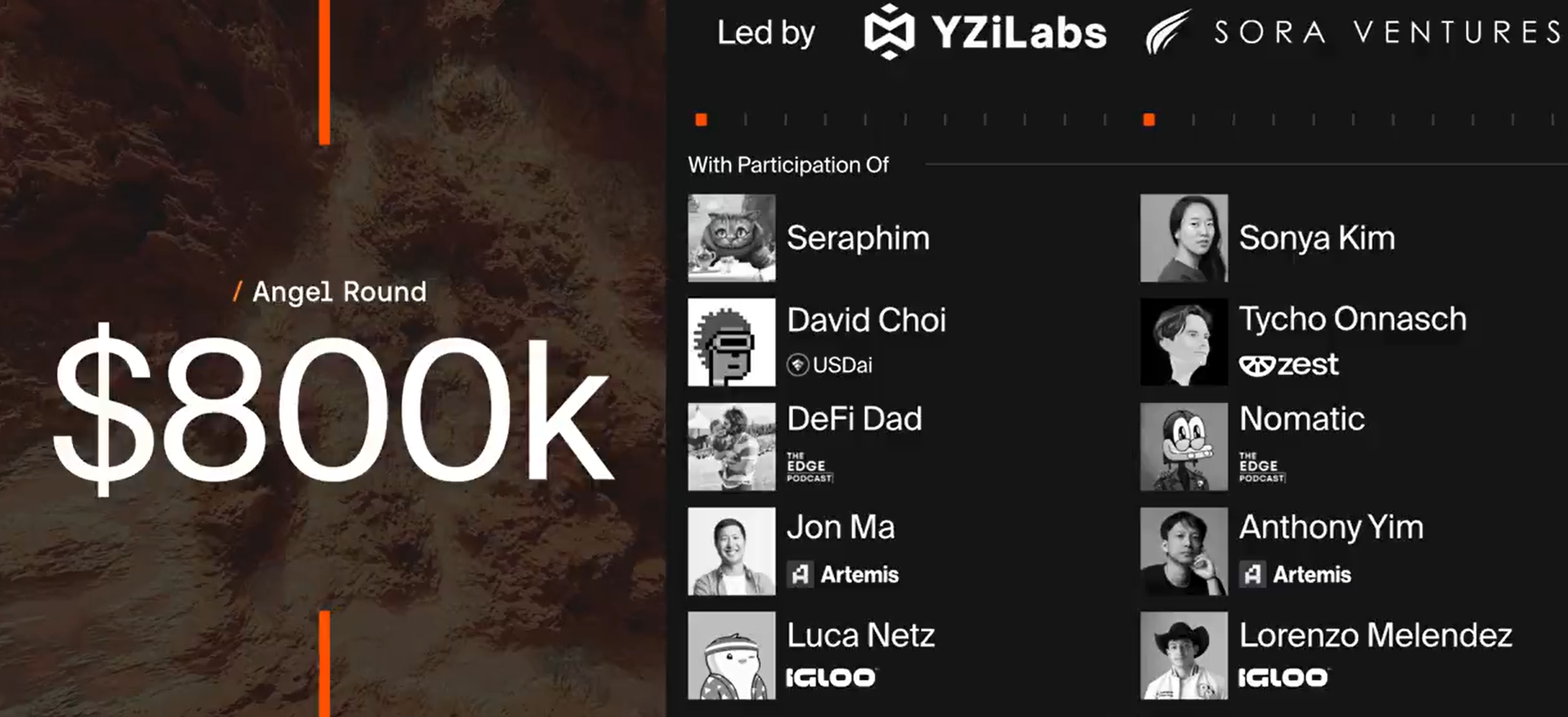
The financing is mainly used for tokenizing institutional credit products like STRC, building the dual-token mechanism, and DeFi integration. Jason Fang, founder of Sora Ventures, stated that the project connects institutional credit products with DeFi infrastructure, providing real yields that traditional stablecoins can hardly achieve. Platforms like RootData record that Saturn accelerated mainnet development after this round of financing.
Currently, Securitize and Clear Street help with its compliant tokenization process. The $10 million deposit during the private test phase provided initial liquidity for subsequent growth.
Saturn's launch comes at a time when DeFi's demand for real yields is heating up. Traditional stablecoins are mostly zero or low-interest, while Bitcoin credit products like STRC provide institutional-grade fixed yield sources. The project indirectly brings Strategy founder Michael Saylor's Bitcoin strategy into DeFi, attracting the attention of some Bitcoin players.
The official emphasizes that all products are available to eligible non-U.S. users, and clearly states that "yields are variable and not guaranteed". However, as an emerging protocol, its actual performance still needs market verification: yield sustainability depends on the stability of STRC dividends, liquidity depth relies on more DeFi integrations, and regulatory compliance risks cannot be ignored.
Note: This article was co-completed by AI tool Grok and author Ma He. All data and facts in the article have been manually verified. Additionally, Ma He participated in adjusting up to 30% of the content.