
In Q1 2026, total DeFi TVL fell 16%. L1s fared even worse: despite commanding 90% of crypto's total market capitalization, nearly every major L1 token posted negative annual returns. The market was voting with real capital, casting doubt on the value capture capacity of L1 blockchains as an infrastructure layer.
When on-chain activity growth fails to translate into L1 token value appreciation, the protocol layer — rather than the infrastructure layer — is capturing an ever-larger share of economic surplus. This forces every L1 to confront a fundamental question: what is a public chain's long-term competitive advantage actually built on?
In this environment, most public chains chose to cut spending, slow development, and wait for warmer conditions. Sui went the opposite direction. In a single quarter, Sui rolled out four tiers of financial infrastructure upgrades in rapid succession: receiving regulatory approcal for major publicly traded ETFs, launching two distinct stablecoins, making margin trading infrastructure upgrades, and kicking off its DeFi Moonshots Program to fund essential financial tooling by builders on Sui.
According to official figures, cumulative stablecoin transfer volume on the Sui network surpassed $1 trillion by the end of March, with a single-month peak of $229 billion in August 2025.
The logic is straightforward: when market cycles suppress token prices, what genuinely builds long-term competitive advantage is the completeness of underlying financial infrastructure. While most chains remain mired in deciding what to prioritize, Sui has delivered its answer — keep building infrastructure in a bear market.
ETF Breakthrough: An Early Crypto Asset to Earn a U.S. Passport
Bitcoin spot ETFs were approved in January 2024, Ethereum followed mid-year, XRP became the first altcoin spot ETF in September 2025, and Solana followed in October. In February 2026, SUI became another early crypto asset to receive SEC approval for a spot ETP in the United States. The first four names on that list are all top-ten assets by market cap with years of established trading history.
For a chain whose mainnet has been live for less than three years, joining this group signals that traditional financial markets have begun treating SUI as an asset class meriting independent allocation. Notably, the SEC's September 2025 adoption of universal listing standards compressed the crypto ETF approval timeline from over 240 days to roughly 75 days — an institutional shift that paved the way for SUI's rapid approval.
Three SUI ETPs launched within a single month, spanning two exchanges and three issuers.
On February 18, Grayscale's GSUI and Canary Capital's SUIS debuted on the same day — the former on NYSE Arca, the latter on Nasdaq. Both feature built-in staking, a first among previously approved BTC and ETH spot ETFs. GSUI stakes 100% of its SUI holdings on-chain, participating in network validation through Sui's delegated proof-of-stake mechanism. As of late March, net staking yield stood at approximately 1.32%, with a 0.35% management fee waived for the first three months or until AUM reaches $1 billion. SUIS posted a staking yield of approximately 7%, with a 0.75% management fee. The substantial yield gap primarily reflects differences in staking strategies and fee structures; investors can select based on their own return and risk preferences.
On February 24, 21Shares' TSUI launched on Nasdaq, offering pure spot SUI exposure with no staking component — a 0.30% management fee waived through October 2026. 21Shares had previously introduced a 2x leveraged SUI ETF (TXXS) in December 2025, carrying a 1.89% management fee and catering to higher-risk investors through a derivatives channel. From leverage to spot to staking, SUI's U.S. ETF product line came to span the full spectrum of risk appetites and return expectations within a single quarter.
The three products' differentiated positioning is unmistakable. Grayscale and Canary Capital opted for staking ETFs that channel on-chain yield to traditional financial investors; 21Shares chose the pure spot route, offering an entry point for institutions seeking straightforward exposure and lower fees.
Staking ETFs carry significance well beyond a simple capital pipeline. In conventional ETF structures, investors gain price exposure while the underlying assets sit idle. Staking SUI ETFs rewrite this logic: once institutional capital enters through the ETF wrapper, the fund stakes SUI on the network to participate in validation and bolster security, with staking rewards flowing back to holders. This creates a bidirectional value loop between traditional capital and the on-chain economy — a structural innovation that neither BTC nor ETH ETFs achieved. SUI ETFs represent the first products to embed on-chain economic incentives within a traditional fund structure.
Prior to this, institutional investors seeking SUI exposure had to navigate OTC desks, high fee custodians, or self-custody — none that gave easy rails in and out of positions without some tradeoffs. ETFs collapse that pathway into a standard equity transaction.
For the Sui ecosystem, the opening of institutional access means the user base and capital pool extend beyond on-chain native participants into the traditional financial system. When a fund manager with a standard brokerage account can buy SUI exposure as effortlessly as buying SPY, this chain's addressable capital pool expands from the tens of billions in crypto-native funds to the trillions managed by traditional asset managers.
Stablecoin Infrastructure: Equipping DeFi with a Settlement Engine
ETFs solved the question of who can enter. Stablecoins address what they transact in once inside. Without mature stablecoin infrastructure, on-chain DeFi resembles plumbing installed but with no water running through it — capital cannot circulate efficiently, and trades lack a stable unit of pricing and settlement.
In the first quarter of 2026, two stablecoin products with entirely distinct approaches launched on Sui in succession, pushing on-chain stablecoin market cap upward from $485 million at the end of 2025.
On February 11, Ethena's synthetic dollar suiUSDe went live on the Sui mainnet. suiUSDe is the Sui-native version of Ethena Labs' synthetic stablecoin, maintaining its dollar peg through a delta-neutral strategy. Unlike conventional fiat-reserve stablecoins, Ethena's model generates yield through crypto long-short hedging, making suiUSDe a natural fit for leveraged trading and yield strategies within DeFi.
The suiUSDe launch was completed in tandem with DeepBook Margin integration. As the first synthetic dollar to plug into DeepBook's margin trading system, it was available for margin trading, lending, and leverage from day one — with no need to wait for protocol-by-protocol integration. This dynamic, where infrastructure readiness equals product readiness, exemplifies the power of composable architecture.
SUI Group Holdings (Nasdaq: SUIG) deployed $10 million into an suiUSDe yield vault on Ember Protocol, with an initial capacity of $25 million. SUIG is a Nasdaq-listed digital asset platform holding approximately 102 million SUI tokens, focused on advancing institutional-grade applications within the Sui ecosystem. A publicly listed company directly participating in on-chain yield vault deployment underscores the shift in the type of capital Sui is attracting — from retail toward institutional. Ecosystem projects including Aftermath, AlphaLend, Bluefin, Navi, Scallop, and Suilend have announced suiUSDe support, spanning lending, trading, and yield aggregation.
USDsui, launched on March 4, followed a fundamentally different path. If suiUSDe serves on-chain DeFi natives, USDsui targets the far larger market of compliant payments and institutional settlement. USDsui is issued by Bridge, a stablecoin infrastructure company acquired by Stripe in 2025, whose Open Issuance platform enables enterprises and networks to rapidly deploy customized stablecoin products.
USDsui's reserves are managed by institutional-grade partners including BlackRock, Fidelity Investments, and Superstate, structured in accordance with GENIUS Act compliance requirements. USDsui's defining feature is interoperability: through Bridge's Open Issuance ecosystem, USDsui can be swapped 1:1 instantly with other Bridge-issued stablecoins, enabling low-friction cross-chain movement. For global payments and DeFi applications, this means a compliant, massively scalable dollar-anchored asset now exists on Sui.
The strategic intent behind these two tracks is evident. suiUSDe serves DeFi-native users, providing underlying assets for yield generation and leveraged trading. USDsui serves payment and compliance use cases, offering institutional-grade reserve-backed stable dollars. This dual-track architecture equips Sui to attract both DeFi capital and traditional institutional funds simultaneously.
Placed in the broader context, global stablecoin market cap reached an all-time high of $316.4 billion in Q1 2026, with monthly transaction volume surpassing $10 trillion. Even amid overall DeFi TVL contraction, stablecoins remain the fastest-growing crypto asset category. Whether a chain's stablecoin infrastructure is robust directly determines how much it can capture from this structural growth wave. Sui's simultaneous launch of dual stablecoin pathways during this window was a carefully calculated positioning play.
DeepBook Margin: The Composable Layer of DeFi Infrastructure
ETFs usher capital in, stablecoins provide a unit of account, but for capital to circulate efficiently on-chain, a unified trading infrastructure integrating order matching, lending, and liquidation is essential. DeepBook Margin fills the most critical link in this chain, advancing Sui from "capital can enter" and "tools exist" to "capital can trade efficiently."
DeepBook is Sui's core liquidity layer — a fully on-chain central limit order book (CLOB). To date, it has processed $18.8 billion in cumulative trading volume, served over 31.4 million users, with roughly $10.5 million in 24-hour volume. Some 26.5 million DEEP tokens have been permanently burned from trading fees.
Atop this battle-tested matching infrastructure, DeepBook Margin introduces margin trading, a liquidation engine, and dynamic interest rate modules, supporting leverage from 1x to 16x. Trades execute automatically via flash loans, completing the full cycle of borrowing, swapping, collateralizing, and repaying in a single transaction. Interest rates are computed dynamically based on pool utilization using a piecewise linear model — gentle at low utilization, spiking steeply once a threshold (e.g., 80%) is breached, balancing supply and demand through market forces. Liquidation is likewise executed entirely on-chain: when a margin account's risk ratio drops below the liquidation threshold, any participant can trigger the process, with liquidators receiving collateral and rewards to protect lenders.
This transforms DeepBook from a matching engine into a full-stack DeFi infrastructure platform. Developers building leveraged trading, lending, or market-making products no longer need to construct margin management and liquidation logic from the ground up.
DeepBook Margin offers a shared, embeddable set of financial primitives that teams can invoke directly, freeing them to focus on product-level innovation and differentiation. Mysten Labs co-founder and Chief Product Officer Adeniyi Abiodun stated that DeepBook Margin represents a new model for on-chain financial infrastructure, with the suiUSDe integration making it the category definer.
Several ecosystem projects have already announced deep integration with DeepBook Margin, including leveraged and derivatives trading, liquidity infrastructure, and lending markets. Abyss, Cetus, and Deeptrade will be the first to integrate margin trading functionality, and other projects can also provide users with richer trading options through shared infrastructure.
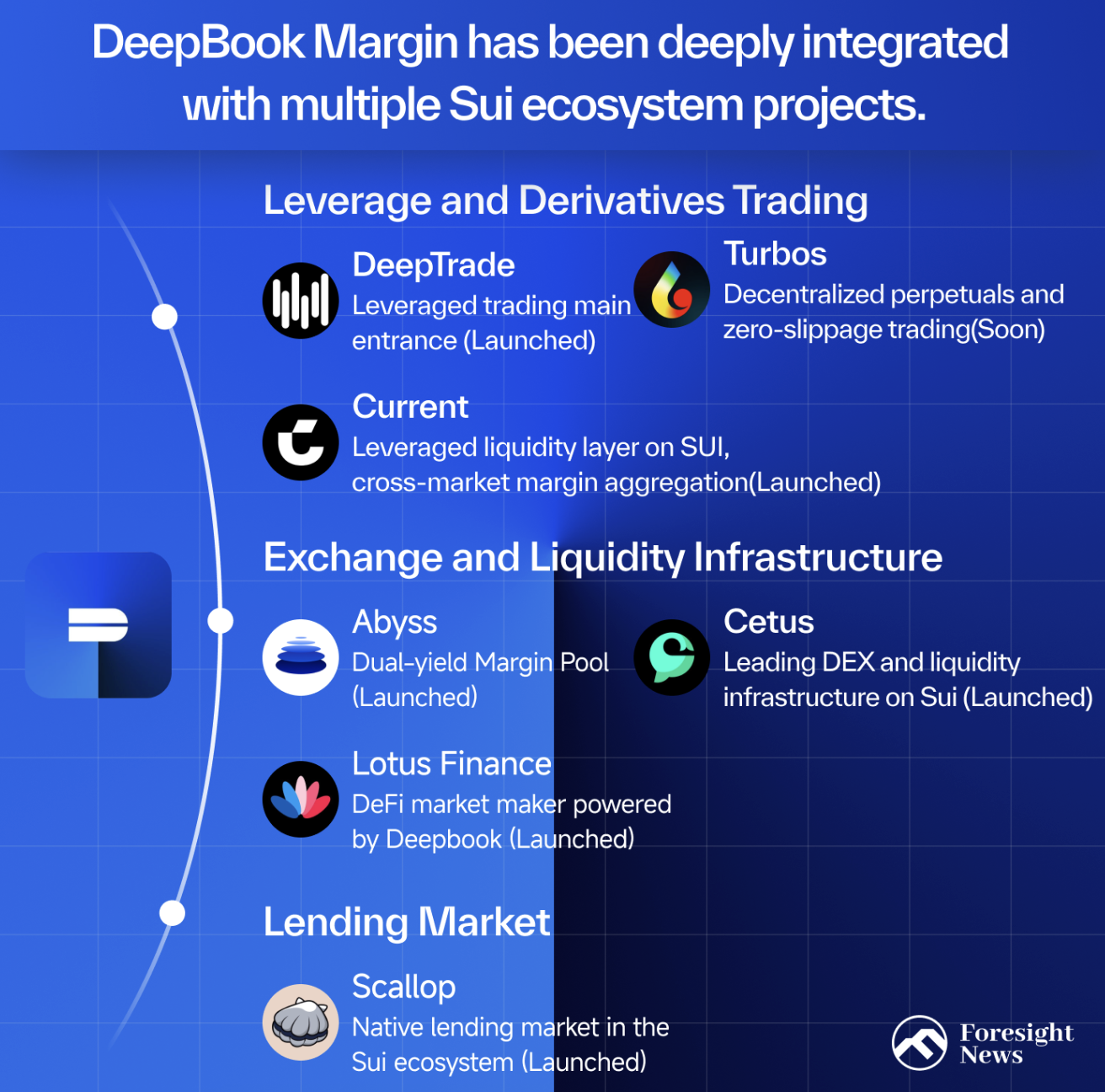
The value of this composability lies in network effects. As more protocols share the same margin and liquidation infrastructure, liquidity ceases to be siloed within individual protocols and flows across the entire DeepBook network. For users, this translates to better price discovery and lower slippage; for developers, lower barriers and faster iteration cycles.
In Ethereum's DeFi ecosystem, each protocol builds its own margin system, resulting in heavily fragmented liquidity with user funds locked in discrete, non-interoperable protocols. Sui opted for a different approach — pushing margin and liquidation down to the infrastructure layer, eliminating liquidity fragmentation at the foundational level.
This also explains why suiUSDe could plug directly into margin trading on launch day — stablecoins and trading infrastructure share the same composable base.
Enabling Builders In a Bear Market
With the recent deployment of ETFs, stablecoins, and DeepBook Margin, Sui has completed a massive, four-tier financial infrastructure overhaul in a single quarter. However, foundational layers are only as valuable as the applications built upon them. To bridge this gap, the Sui Foundation launched DeFi Moonshots, a highly selective incentive program designed to turn this "infrastructure flywheel." Unlike traditional broad-reach grants, Moonshots targets a small cohort of category-defining pioneers, offering up to $500,000 in growth incentives and direct technical collaboration to ensure that this freshly laid foundation converts into tangible ecosystem output.
This aggressive expansion represents a textbook counter-cyclical bet: accelerating development while the broader market faces contraction and pressure. By prioritizing a systematically complete financial stack—from institutional settlement to permissionless innovation—Sui is positioning itself to reap outsized dividends when the cycle turns. Whether or not the market immediately rewards the token price, the Q1 scorecard suggests that Sui’s competitive edge now rests on the sheer completeness of its infrastructure, effectively wagering that the chain that builds its foundations first will be the one to lead the eventual recovery.