
Sometimes, clarifying what cannot be done actually leaves a gray area.
Written by: Eric, Foresight News
Recently, Binance released a risk alert for market makers in the cryptocurrency market, along with a guide for project parties and users. Many interpreted this as Binance tightening its control over market makers, but the guide does not explicitly mention an upgrade in control; it mainly reminds project parties and users to be vigilant against some market makers' malicious behaviors.
Binance's current supervision and punishment for market manipulation still follow the "Binance Market Monitoring Program" mentioned in its article published in February 2025, focusing on three types of market manipulation behaviors:
- Spoofing: Placing a large number of fake orders to mislead others' judgment of supply and demand, then canceling these orders quickly;
- Wash Trading: The only purpose of an entity buying and selling assets is to artificially inflate its trading volume;
- Pump and Dump: Artificially inflating prices through coordinated efforts, then conducting organized sell-offs.
In this risk alert, Binance highlighted six market performances that may involve manipulative behaviors, including sales conflicting with token issuance plans, one-sided trading, cross-platform coordinated sell-offs, volume inconsistent with price trends, price surges or crashes when liquidity is insufficient, and imbalance between trading volume and liquidity.
For users who frequently participate in trading, especially those in crypto trading, the above situations have been seen more or less, and some are even victims of market manipulation. Even if Binance did not further raise its standards, the publication of the article itself shows a strict attitude towards market manipulation by market makers. Binance stated at the end of the article that it will take quick and decisive measures against any violations, including blacklisting non-compliant market makers.
However, in the more than 20 days after this article was published, there have been frequent "roller-coaster" price movements of tokens...
Unruly Coins That Surge Dozens of Times in a Week
If a token's price shows a one-sided trend in a short period and can maintain the trend afterward, it is generally considered the result of market consensus. However, if there are sharp rises and falls in a short time, even if not intentionally done by market makers, it is most likely market manipulation by some large funds.
The most representative tokens with abnormal price movements recently are STO and RAVE.
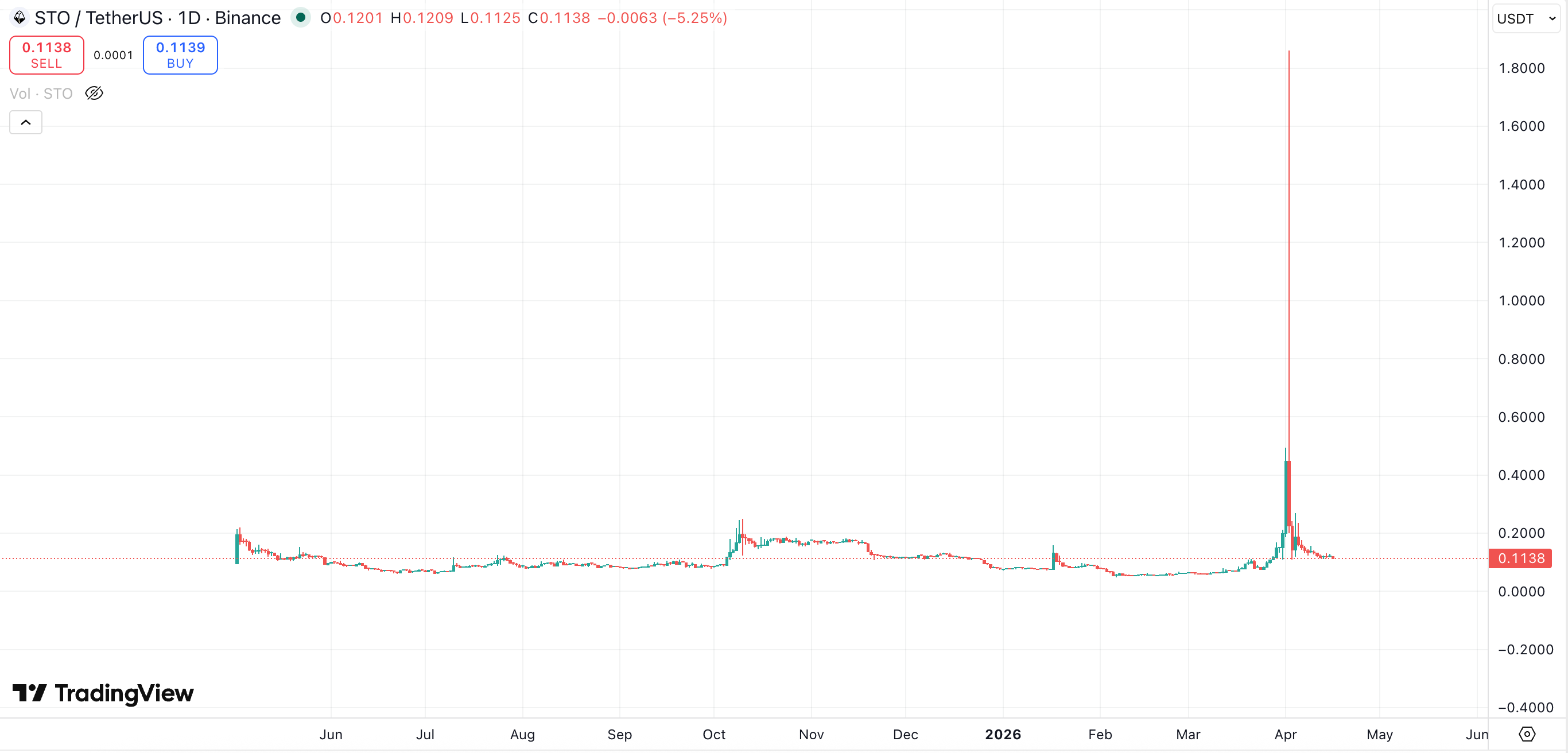
StakeStone's token STO started to rise after hitting a low of $0.0727 on March 25, reaching around $0.2 seven days later. Then it rose to a high of around $1.8 in the next two days, an increase of nearly 25 times in nine days. As a project that has raised over $30 million with investors including Polychain Capital, YZi Labs, and OKX Ventures, a sharp rise is not uncommon. However, what is outrageous is that after hitting a price six times its previous high, STO fell back to around $0.11 in less than two days.
From the chart, this extreme trend is a typical example of "pump and dump". On-chain large transfer data also confirms this.
According to Lookonchain's monitoring, a newly created address transferred a total of about 25.5 million STO from Binance on March 31 and April 1, accounting for 11.32% of the circulating supply. The timing coincided with the two days before STO's roller-coaster movement from around $0.5 to $1.8 and then back to $0.2.
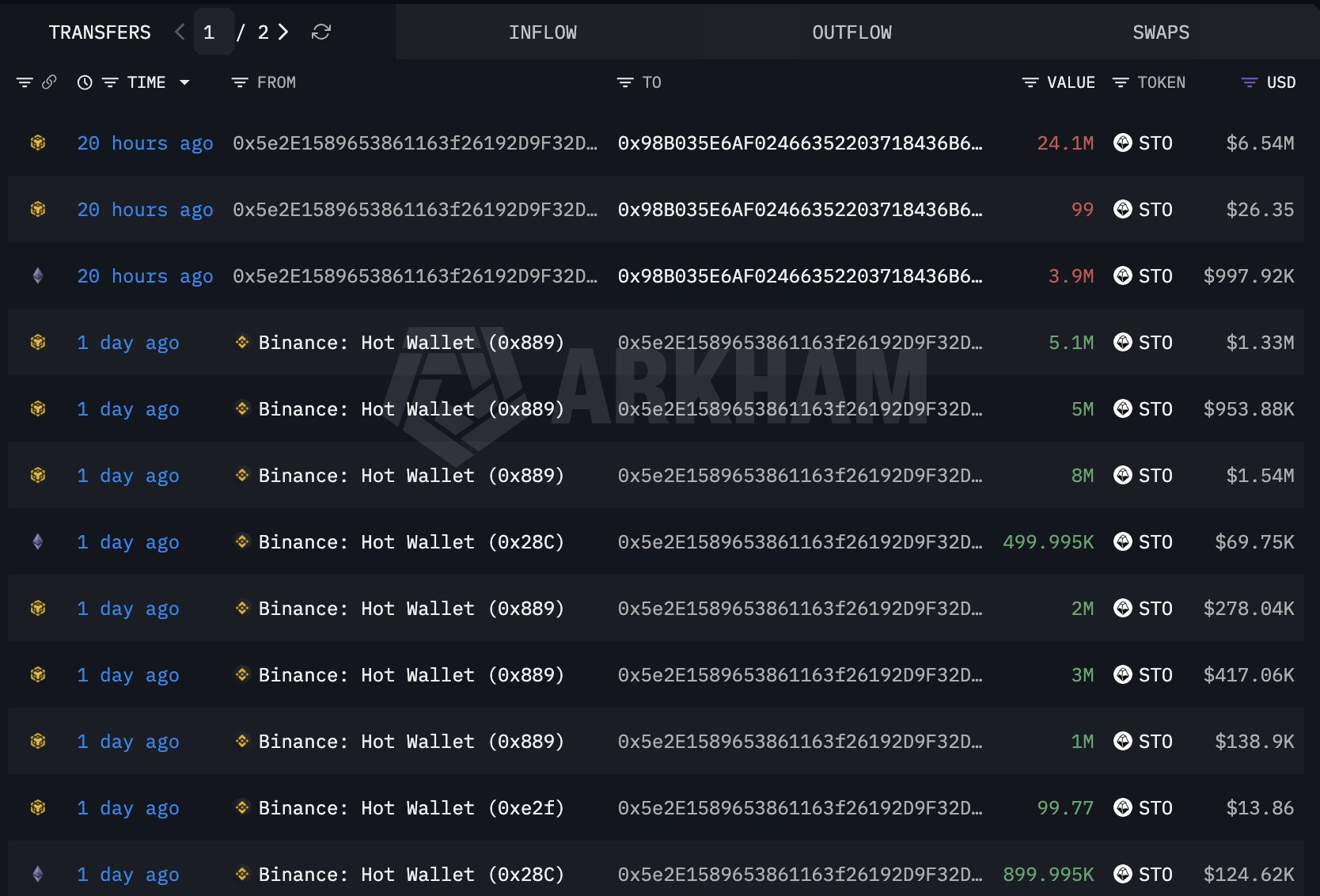
On the day of the roller-coaster movement, this newly created address starting with 0x5e2 deposited the tokens withdrawn from Binance, along with a total of about 28 million STO obtained from other channels (accounting for about 12.43% of the circulating supply) into Gate.io.
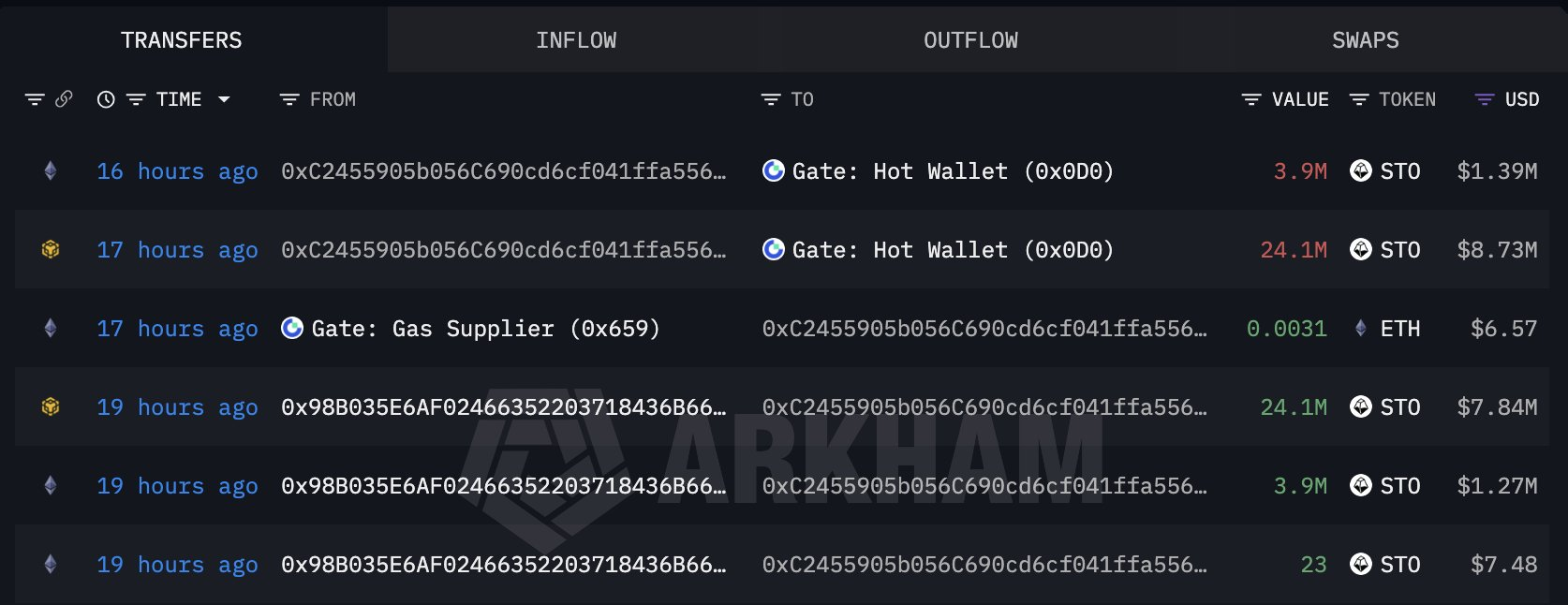
Although we have no way of knowing the internal operations of the exchanges, this exact timing correspondence almost proves that this is a typical market manipulation: the manipulator bought a large number of tokens at a low price and transferred them out of the exchange for storage, used insufficient liquidity to pull up the price at low cost, and then quickly sold the hoarded tokens. Of course, investors who followed the market to buy and short sellers who were liquidated in the contract market also contributed to the price fluctuations.
The situation of the RAVE token is believed to be caused by manipulative behavior that profits in the contract market by influencing the spot price.
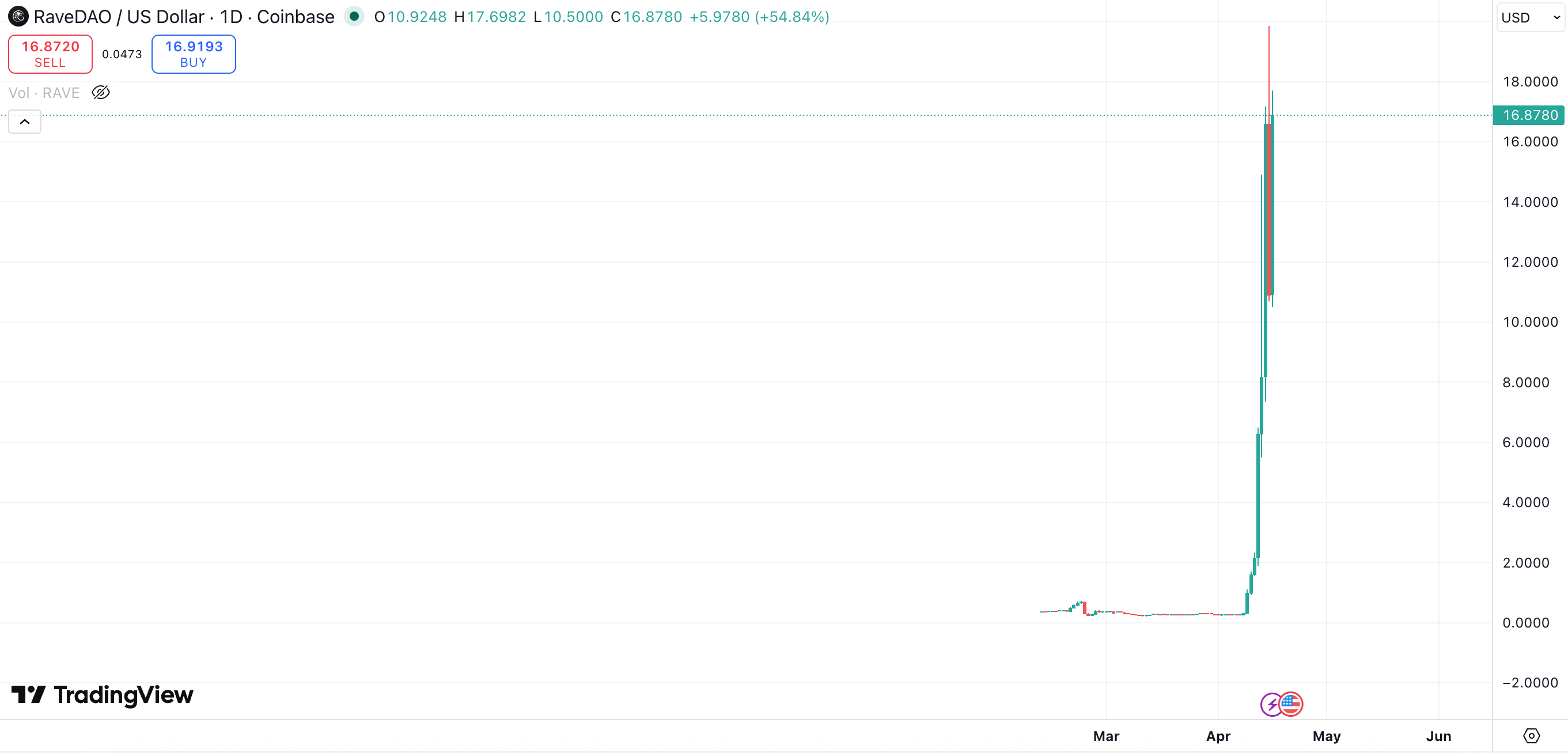
RAVE's price has been hovering between $0.2 and $0.3 for the past two months. Starting from April 9, it suddenly began to rise sharply, reaching a high of nearly $20 in seven days, creating a "miracle" of nearly 100 times increase.
Behind this bizarre trend are also abnormal large on-chain movements. According to Ai Yi's monitoring, at the start of RAVE's rise, two addresses suspected to belong to the same entity transferred a total of 18.58 million RAVE to Bitget. Later, the two addresses continued to transfer, with a total of about 30.58 million RAVE transferred in three days, accounting for about 12% of the total circulating supply.
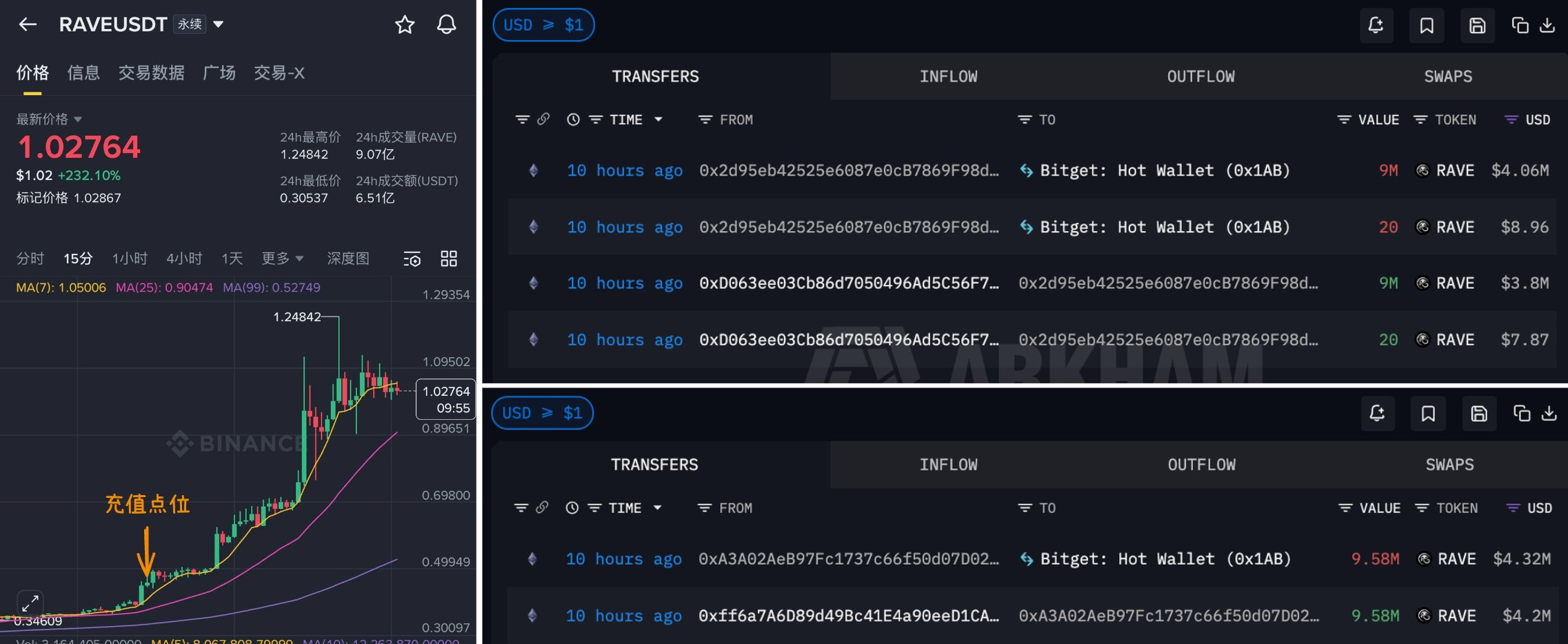
But soon, the relevant addresses transferred about 31.94 million RAVE out of Bitget. Many analysts believe this move was to create the illusion of "whales selling" by transferring large amounts into the exchange, and the subsequent continuous rise was to profit from going long in the contract market. Currently, RAVE's price is still rising, and there have been no large transfers into the exchange for the time being.
According to on-chain data, the top 10 RAVE holders hold 98% of the total tokens. Currently, RAVE's price has not fallen sharply like STO, which may mean that the market manipulation has not ended, or the manipulator believes that the spot market has insufficient liquidity and has no plan to cash out through the spot market.
Policies at the Top, Countermeasures at the Bottom
Recently, there are not a few tokens with similar abnormal chart movements and accompanying large on-chain transfers; SIREN, ARIA, etc. have also experienced sharp rises and falls within a few days. However, if we analyze the specific situations of these "unruly coins", we will find that they did not violate the rules set by Binance.
For the STO manipulator, although there was indeed a large withdrawal from Binance, this action did not violate any regulations. Moreover, STO is listed on many exchanges, so the manipulator may not have operated the price on Binance. Even if the manipulator influenced the price through a Binance account, Binance banning the account would not have a big impact, because the manipulator's main profit came from selling spot on Gate.io.
RAVE's manipulation is more hidden. Binance only launched the contract trading market for RAVE. The manipulator can completely spread small long positions across multiple accounts, then influence the price on Bitget to profit, and Binance may not even be the manipulator's "main battlefield". For dozens or even hundreds of ordinary accounts that have passed KYC, as long as they pay attention to diversifying the sources of USDT in each address, even if Binance finds doubts, it cannot produce sufficient evidence to prove that these accounts are definitely related to market manipulation.
As for some tokens listed on Binance Alpha, due to their limited liquidity and low total market value, a small amount of funds can completely influence the price trend, and in many cases, it may not even be considered manipulation.
These actual cases have sounded an alarm for both investors and exchanges. Insider trading and market manipulation have been rampant in the cryptocurrency industry until now, causing heavy losses to many investors. The industry has been calling for exchanges to strengthen control. In recent years, many exchanges have successively announced punishment measures for market manipulation, but "being indecisive in anti-manipulation" means "resolutely not anti-manipulation". Although exchanges do not intend to let it go, the existence of rules means that not violating the rules is allowed, and the ambiguity of the rules actually gives a green light to malicious behaviors that bypass the rules.
Simply controlling manipulation within a single exchange is very easy for veterans in the financial market to bypass, and STO and RAVE are very realistic examples. In addition to monitoring and punishing obvious manipulative behaviors, exchanges should also establish response measures for related behaviors that may involve market manipulation, and establish cross-exchange abnormal behavior monitoring. For example, in the STO manipulation case, after the huge amount of tokens withdrawn from Binance were all transferred to Gate.io, Gate.io should take measures such as suspending trading functions once it detects the account's selling behavior to prevent the malicious behavior from continuing.
Recently, many exchanges have launched trading of tokenized US stocks. For cryptocurrency exchanges, in addition to supporting US stock trading, they should also learn from the mature system established by US stocks through perfect regulatory mechanisms and strict punishment measures. This world's largest capital market has proven one thing over a hundred years: trust is the way to last.